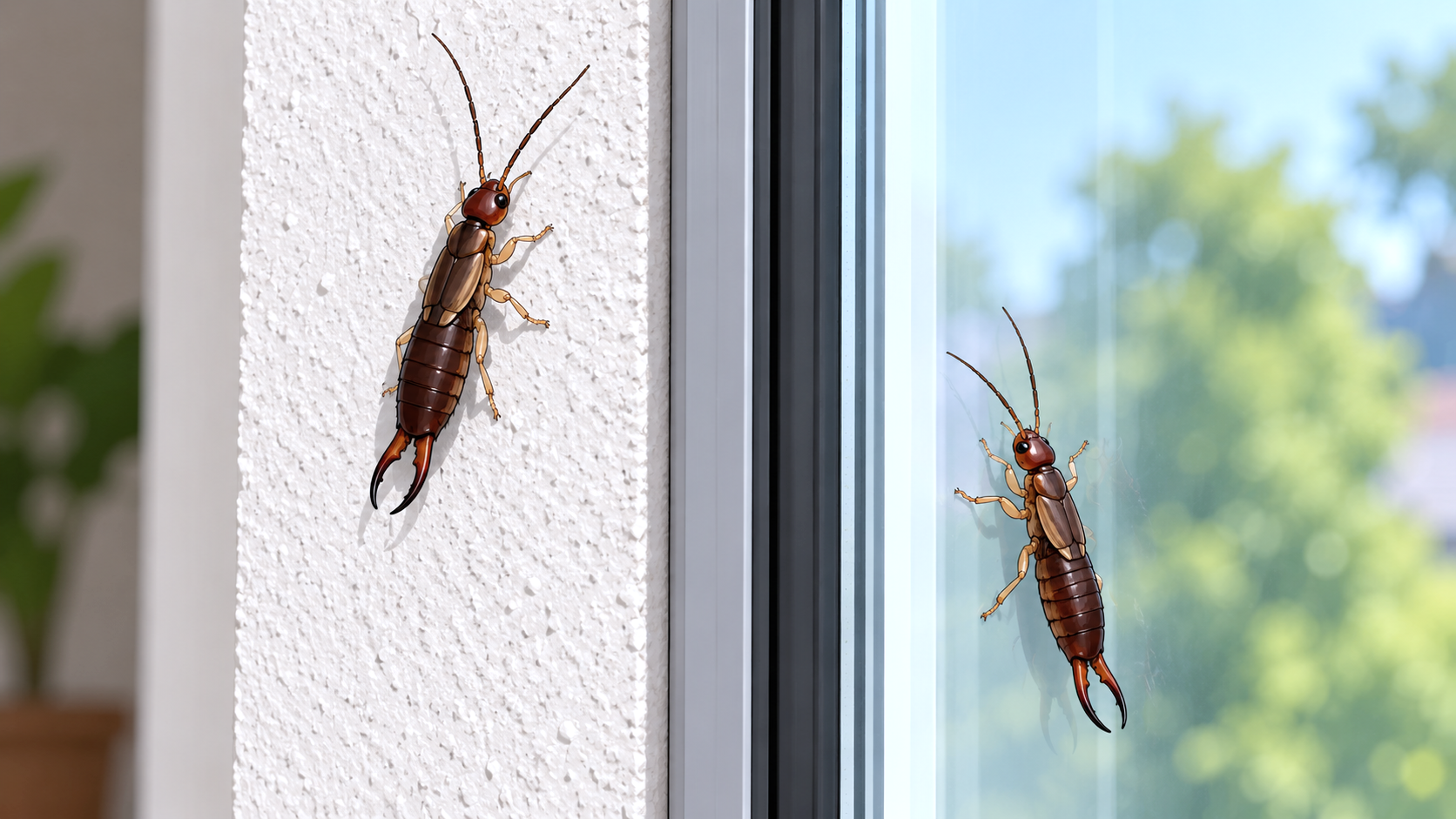
An earwig halfway up a wall is not unusual, but putting the same insect against clean glass changes the challenge considerably. Wall texture gives its feet places to grip, while a very smooth surface removes much of that purchase. Earwigs can climb walls, plants, wood and many other vertical surfaces. Their ability to climb very smooth surfaces such as clean glass depends on the attachment structures of the particular earwig, and smooth glass can be much harder to scale than a textured wall. Earwigs are therefore capable climbers, but they should not be treated as equally effective on every surface.
Earwigs Can Climb Vertical Surfaces
Earwigs are primarily crawling insects, and their movement is not restricted to the ground. They can move up vegetation and other vertical structures while searching for food or shelter. Research on the predatory earwig Labidura riparia, for example, has documented individuals climbing cotton plants to reach insect eggs.
That ability makes sense when you consider where earwigs normally live. They spend much of their time around soil, plants, mulch, bark, debris and protected crevices. European earwigs are also most active at night, so much of their climbing can happen when nobody is watching.
Consequently, finding an earwig above floor level does not mean it flew there. Although European earwigs possess wings, they rarely fly. Crawling is the much more ordinary explanation for an earwig found on a wall, plant or other raised surface. We cover their unusual folded wings separately in our guide to whether earwigs can fly.
A Rough Wall Is Much Easier Than Clean Glass
The useful distinction is not simply horizontal versus vertical. Surface texture matters.
Insects can use the claws at the ends of their legs to catch tiny irregularities in a surface. Even something that looks reasonably smooth to us may contain enough microscopic texture for an insect to gain traction. This is why brick, unfinished wood, bark and other irregular surfaces present a very different climbing problem from polished glass.
Earwigs have three-segmented feet, or tarsi. The precise attachment equipment is not identical across the entire order Dermaptera. A comparative study of 18 earwig species found a wide range of attachment structures, including smooth pads, hairy attachment surfaces and other specialized structures. Some groups have lost structures found in others.
That variation is important. It means a blanket statement that every earwig has the same “sticky feet” and can effortlessly climb any smooth material would be inaccurate.
For the European earwig, Forficula auricularia, the second tarsal segment has a distinctive expanded shape. This is one of the anatomical features used to identify members of its family. Its feet are well suited to moving over the varied surfaces it encounters in its terrestrial habitat, but clean glass removes the obvious irregularities that claws can exploit on a rougher wall.
Can Earwigs Climb Glass?
Glass deserves a separate answer because it is an unusually smooth climbing surface.
Some earwig species possess specialized attachment structures that improve adhesion. Research on earwig feet has found that Dermaptera evolved several different attachment systems rather than one universal design. In one species, Timomenus komarovi, researchers documented hairy attachment pads associated with climbing vertical surfaces.
However, those findings cannot simply be transferred to every earwig species. The broader anatomical research shows considerable variation among earwig families, including the presence, reduction or absence of different attachment structures.
So we would not use clean glass as an absolute “earwig-proof” barrier for every species. At the same time, an earwig that easily crosses wood, bark or a painted textured wall should not automatically be expected to perform equally well on clean vertical glass.
That distinction is more useful than a universal yes or no. Earwigs are capable vertical climbers, while their performance on very smooth glass varies with their attachment anatomy and the surface they are trying to cross.
Why You Might Find an Earwig High on an Indoor Wall
Finding an earwig several feet above the floor can make its route into the room seem mysterious. The height itself is not evidence that the insect entered at that level.
Earwigs can enter homes and other buildings, then continue crawling after they get inside. They are nocturnal and normally seek dark, confined and damp hiding places during daylight. An individual wandering at night can therefore cover more of a room than its eventual resting position suggests.
This is especially worth remembering when trying to work out why earwigs are appearing in your house. The place where you notice one is not necessarily the entry point.
An earwig on a bathroom wall, for example, could have entered through a lower opening and climbed afterward. The same principle applies to an insect discovered near a window. Its final position tells you where the earwig ended up, not necessarily how it entered.
Climbing Plants Is More Important to Earwigs Than Climbing Your Walls
The climbing ability becomes more ecologically useful outdoors. Earwigs are omnivorous and can feed on plant material as well as other small organisms. Their ability to move through vegetation gives them access to leaves, flowers and prey above ground level.
That creates the interesting situation where climbing can make an earwig either useful or troublesome in a garden. Earwigs can prey on other organisms, yet they can also chew plants. Our guide to whether earwigs are good or bad for the garden covers that tradeoff in more detail.
It also explains why finding damage higher on a plant does not rule earwigs out simply because they usually shelter near ground level. Earwigs can leave those shelters after dark and climb vegetation to feed. When plant damage is suspected, checking the plant with a flashlight at night is more informative than assuming a ground-dwelling hiding place means a ground-level feeding range.
A High Earwig Sighting Does Not Tell You Where to Seal
For homeowners, this is the part of earwig climbing behavior we find most useful. Do not start sealing a wall at the exact height where you saw the insect.
Instead, inspect the routes that a crawling insect could actually use. Exterior doors, windows, foundation openings, utility penetrations and other gaps can provide access. Vegetation or objects touching the building can also create continuous routes from outdoor habitat onto the structure.
Reducing favorable conditions around the foundation matters as well. Earwigs favor moist, protected places, so excess moisture and abundant hiding sites near a building can keep more insects close to potential entrances. Our guide to what attracts earwigs explains those conditions separately.
Once earwigs are indoors, they do not establish reproducing indoor populations. Physical removal is usually enough for individual insects. For repeated entry, the more useful response is to keep earwigs out of the house by addressing access points and conditions around the exterior rather than worrying about how high they can climb.
Other Questions About Earwig Climbing
Can earwigs climb upside down?
Attachment ability varies among earwig species because their feet do not all have the same attachment structures. Moving upside down also demands more adhesion than walking across a horizontal surface, so the answer cannot be generalized to every earwig and every material.
Can baby earwigs climb?
Earwig nymphs are mobile and resemble smaller versions of adults. They leave the maternal nest as they develop and forage in their surroundings. You can see how their appearance changes in our guide to baby earwigs.
Can earwigs climb into a bed?
A bed is not inaccessible simply because it stands above the floor. Earwigs can crawl and climb, although they do not live on people or seek beds as a feeding habitat. An occasional earwig found in a bed is different from an insect adapted to living there.
Can earwigs climb out of a container?
That depends on the container’s inner surface and design. A textured side can provide more opportunities for traction than a very smooth vertical surface. Therefore, an open container should not automatically be treated as secure simply because its sides look steep.
Can earwigs climb ceilings?
Some earwig species have specialized foot structures capable of substantial attachment to surfaces, but those structures vary across Dermaptera. Seeing an earwig above floor level is entirely consistent with its climbing ability, while inverted movement depends more heavily on the species and the surface involved.
One thought on “Can Earwigs Climb Walls or Glass?”