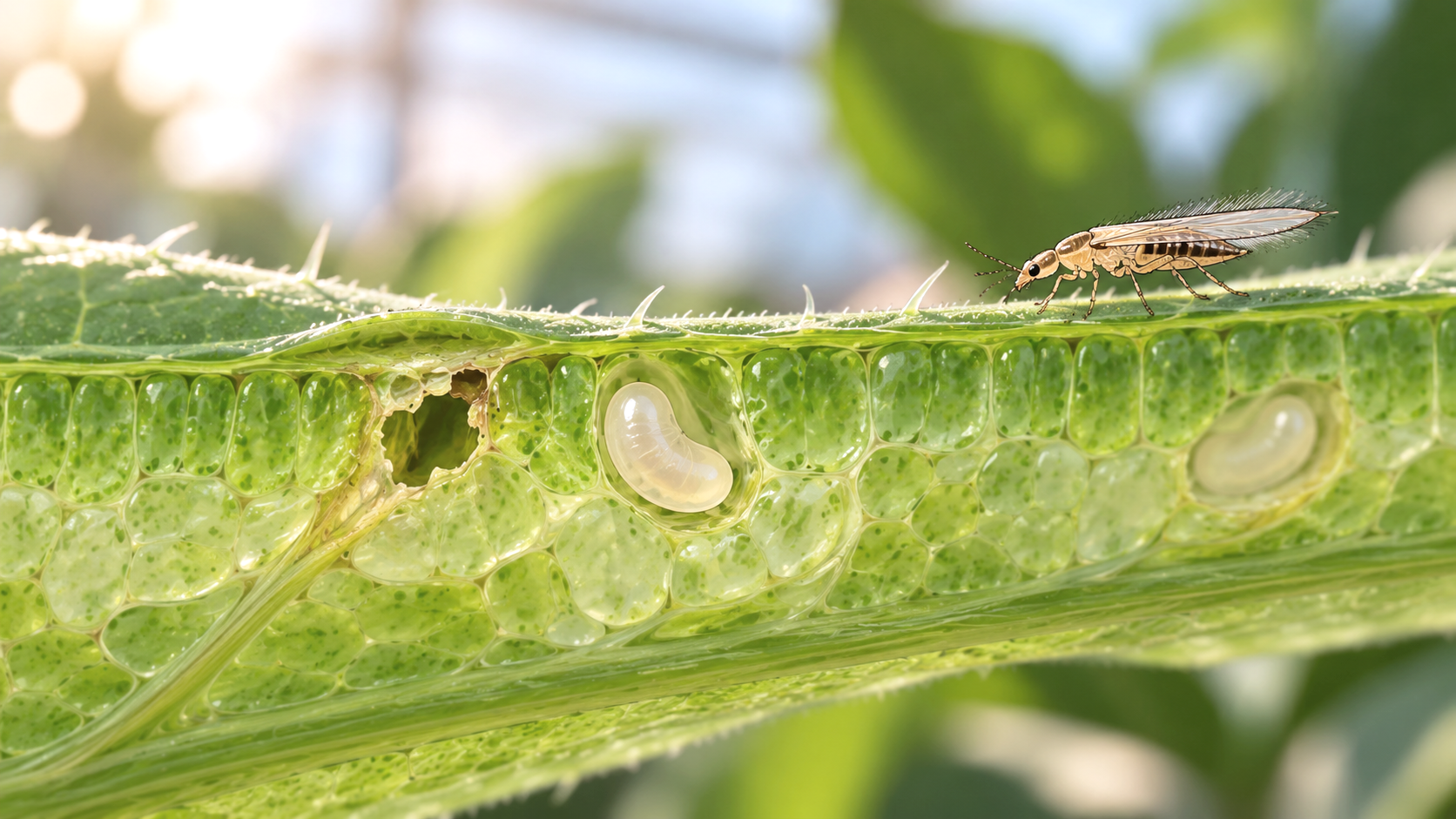
Thrips eggs are extremely small, pale eggs that are generally elongated, cylindrical, oval, or kidney-shaped, depending on the species. They are commonly translucent white, whitish, cream, or beige. However, you often cannot see the complete egg because females of many plant-feeding thrips insert their eggs partly or completely into leaves, buds, flowers, or other plant tissue.
That hidden placement is one reason searching a plant for obvious clusters of eggs is not a reliable way to rule thrips in or out. A plant can contain developing thrips eggs while showing very little on its surface. Other species place their eggs more openly, so there is no single egg-laying pattern that applies to every thrips. The combination of tiny size, pale coloration, and concealed placement makes the egg stage considerably harder to find than the moving larvae and adults.
What Shape Are Thrips Eggs?
There is no single shape shared by every species, although thrips eggs are generally elongated rather than perfectly round. The eggs of most plant-feeding thrips are described as elongated and ranging from cylindrical to kidney-shaped. A kidney-shaped egg has a slight indentation along one side rather than forming a completely straight oval. These differences are subtle, particularly at the scale involved, so you normally need magnification to appreciate the actual outline.
Species differences can be quite noticeable once the eggs are viewed closely. Predatory Franklinothrips, for example, produce kidney-shaped, translucent white eggs, while Cuban laurel thrips have smooth cylindrical eggs with rounded ends. Weeping fig thrips eggs are described as oval. Therefore, “tiny white oval” is a reasonable first impression of some thrips eggs, but it is not a precise description of every species.
What Color Are Thrips Eggs?
Thrips eggs are usually pale. Depending on the species, they may appear translucent white, whitish, cream, or beige. Cuban laurel thrips eggs, for example, are beige to translucent white, while weeping fig thrips eggs are whitish. Their pale appearance is quite different from the much broader range of colors adult and immature thrips can display.
Color becomes less useful when the egg sits inside plant tissue. In that situation, you may be seeing the plant surface over the egg rather than the egg itself. Lighting, the thickness of the surrounding tissue, and the egg’s developmental stage can also affect what is visible. Consequently, searching for a particular shade of white or cream is less useful than understanding where the species places its eggs and what, if anything, can be seen on the plant surface.
How Big Are Thrips Eggs?
Thrips eggs are tiny enough that examining their shape without magnification can be difficult. Exact dimensions vary by species, so one measurement should not be applied to every thrips egg. As a documented example, Franklinothrips eggs are approximately 0.6 millimeter (1/40 inch) long. These 0.6-millimeter eggs are kidney-shaped and translucent white.
That measurement also puts the scale into perspective. Even an egg that is more than half a millimeter long is easy to miss when it is pale and partly concealed inside a leaf. Other thrips species have their own egg dimensions, just as adults vary considerably in size. Our article on how big thrips are deals with adult and overall size variation, but the useful point here is simpler: thrips eggs are small enough that a hand lens can make inspection much more productive.
Where Do Thrips Lay Their Eggs?
Many plant-feeding thrips insert their eggs into plant tissue. Depending on the species, that can mean leaves, buds, flowers, fruit surfaces, or other tissues where the newly hatched larvae will have access to suitable feeding sites. Western flower thrips provide a familiar example because females insert their eggs into plant tissue rather than leaving exposed clusters on the leaf surface. Chilli thrips likewise insert eggs into plant tissue, commonly in buds and on the undersides of leaves.
However, thrips do not all use the same egg-laying strategy. Some gall-forming species place eggs on leaf surfaces inside the folded or distorted tissue created by their activity. Myoporum thrips have relatively large white eggs deposited on leaf surfaces within distorted growth, while Cuban laurel and weeping fig thrips also lay eggs within protected galled tissue. The different species of thrips therefore matter when deciding where eggs are likely to be located.
Are Thrips Eggs Laid Inside Leaves?
Many are, but not all. Females of numerous plant-feeding species use an egg-laying structure called an ovipositor to place eggs within plant tissue. Western flower thrips are among the species that use this strategy. Once inserted, the egg can be largely hidden beneath the plant surface, leaving little for someone inspecting the leaf to see.
Greenhouse thrips also insert their eggs into leaf or fruit tissue. As those greenhouse thrips eggs approach hatching, small swellings known as egg blisters can develop in the plant surface and become visible with a hand lens. In that situation, the visible clue is not an exposed egg sitting on top of the leaf. You are seeing the effect of the developing egg beneath the surface.
This difference is worth remembering when comparing photographs online. A clear macro image of a removed thrips egg does not necessarily represent what you would actually see while examining an infested plant.
Can You See Thrips Eggs With the Naked Eye?
A thrips egg may be physically large enough to register as a minute speck when exposed, but reliably recognizing one as a thrips egg with the naked eye is another matter. Its tiny dimensions and pale coloration already make identification difficult. When the egg is inserted into plant tissue, much or all of it may be concealed.
A hand lens is therefore far more useful when looking for eggs or the surface changes associated with them. Even then, finding a tiny pale structure does not automatically prove that it is a thrips egg. Plant surfaces contain hairs, glands, debris, pollen, and eggs from other arthropods that can all become confusing at small scales. We would put much more weight on a combination of evidence, including the presence of insects matching the appearance of thrips and characteristic signs elsewhere on the plant.
Do Thrips Lay Their Eggs in Clusters?
Do not expect every thrips species to leave an obvious exposed mass of eggs. Many females deposit eggs individually in or on suitable plant tissue. Franklinothrips females, for example, insert their eggs singly into plant tissue, leaving only part of the egg exposed. Other species can place multiple eggs within the same protected area, but the result still may not resemble a conspicuous egg cluster sitting openly on a leaf.
This matters because photographs of highly visible insect egg masses can create the wrong search image. Thrips reproduction is often much less obvious. You may encounter several larvae on a plant without ever having noticed the eggs from which they hatched. Once hatching occurs, the young insects enter the first of the feeding immature stages described in the thrips life cycle.
What Do Western Flower Thrips Eggs Look Like on a Plant?
Western flower thrips (Frankliniella occidentalis) females insert their eggs into plant tissue. Therefore, the most important identification feature for a homeowner is not the appearance of a loose exposed egg. It is the fact that the egg normally develops within the plant rather than sitting conspicuously on the surface. This can make the egg stage easy to overlook even when adults are actively reproducing.
The location also explains why examining flowers or leaves for exposed eggs may produce nothing useful. Western flower thrips can still be present even when no recognizable eggs are visible. Their adults and feeding larvae are usually more practical targets for visual inspection. Once the eggs hatch, the young thrips become wingless feeding larvae before progressing through the later nonfeeding stages of development.
What Do Cuban Laurel and Weeping Fig Thrips Eggs Look Like?
Cuban laurel thrips (Gynaikothrips ficorum) provide a useful example of eggs that can occur on a leaf surface rather than being deeply concealed inside normal plant tissue. Their eggs are beige to translucent white, cylindrical, smooth, and rounded at the ends. However, they occur inside the rolled or folded ficus leaves produced by the infestation, so the surrounding distorted foliage still provides considerable protection. The eggs and other developmental stages of Cuban laurel thrips can remain within these galled leaf terminals.
Weeping fig thrips (Gynaikothrips uzeli) use a similar protected environment. Their eggs are oval and whitish and occur on leaf surfaces within galled tissue. The two species are closely similar as adults, but their preferred ficus hosts differ. These examples show why “thrips eggs are inserted into leaves” is too broad to use as a universal rule.
What Do Myoporum Thrips Eggs Look Like?
Myoporum thrips (Klambothrips myopori) produce oblong white eggs that are relatively large compared with the adult female. Rather than hiding the eggs deeply inside normal leaf tissue, females deposit them on leaf surfaces within the distorted growth created by the infestation. Photographs of myoporum thrips eggs in twisted leaf tissue show how the plant itself creates a protected environment around them.
This species also demonstrates why egg location can sometimes be more useful than egg color. A tiny white object on an ordinary exposed leaf could be many things. Finding oblong white eggs alongside different thrips life stages within characteristic twisted myoporum growth creates a much stronger identification picture. In fact, eggs, larvae, prepupae, pupae, and adults can all occur within the affected tissue.
Can Thrips Eggs Be Mistaken for Something Else?
Yes. At this scale, a pale speck on a plant should not automatically be called a thrips egg. Tiny arthropod eggs, pollen, plant structures, dried residues, and debris can all look similar without adequate magnification. The problem becomes even greater when a photograph lacks a scale reference and has been enlarged enough that a fraction-of-a-millimeter object fills the screen.
Egg shape can help once you have a clear close view, but context still matters. Look at where the object occurs, whether adult or immature thrips are present, and whether the plant shows other evidence consistent with thrips activity. Our overview of signs of a thrips infestation covers those broader clues. An isolated pale speck is weak evidence on its own, while multiple independent signs make the identification much more convincing.
What Happens After a Thrips Egg Hatches?
Hatching begins the actively feeding part of immature development. The young thrips enters its first larval instar and later molts into a second feeding instar. These stages are wingless and generally paler than the adults. After the two feeding stages, the insect progresses into the nonfeeding prepupal and pupal stages before reaching adulthood.
If you are checking an affected plant, the newly hatched larvae are often easier to detect than the eggs because they move and feed rather than remaining embedded or concealed in one spot. Learning what thrips larvae and nymphs look like can therefore be more useful for confirming an active population than searching indefinitely for eggs you may never be able to see clearly.
Check the Whole Plant Instead of Searching Only for Eggs
When thrips are suspected, do not make egg hunting the entire inspection. Examine tender leaves, buds, flowers, growing tips, leaf undersides, and protected plant structures where appropriate for the species. A hand lens can help reveal small insects and surface details that are almost impossible to judge accurately with normal vision. You can also gently shake suitable foliage or flowers over white paper to dislodge mobile thrips and make them easier to see.
Finding adults or feeding larvae alongside characteristic plant symptoms usually provides more useful evidence than failing to find hidden eggs. Many thrips eggs are deliberately placed where they are difficult to see, so their absence during an inspection proves very little. Instead, build the identification from several clues and determine whether the insects present are actually associated with the plant symptoms before considering control.
More Questions About Thrips Eggs
Do thrips eggs move?
No. The egg itself remains where the female deposited it until the developing thrips hatches. Movement begins after the first larval stage emerges.
Are thrips eggs hard or soft?
Thrips eggs have an outer egg covering, but their minute size makes texture a poor practical identification characteristic. Shape, placement, associated thrips, and magnified appearance provide more useful clues.
Can thrips eggs be found in flowers?
Yes. Females of plant-feeding thrips can place eggs in buds, leaves, and other plant tissues associated with larval feeding sites. The exact placement varies among species.
Are all white dots on a thrips-infested leaf eggs?
No. White or pale material on a plant can have many causes, including plant structures, debris, and other arthropods. Thrips eggs should be identified from their appearance and placement together with other evidence, not from color alone.