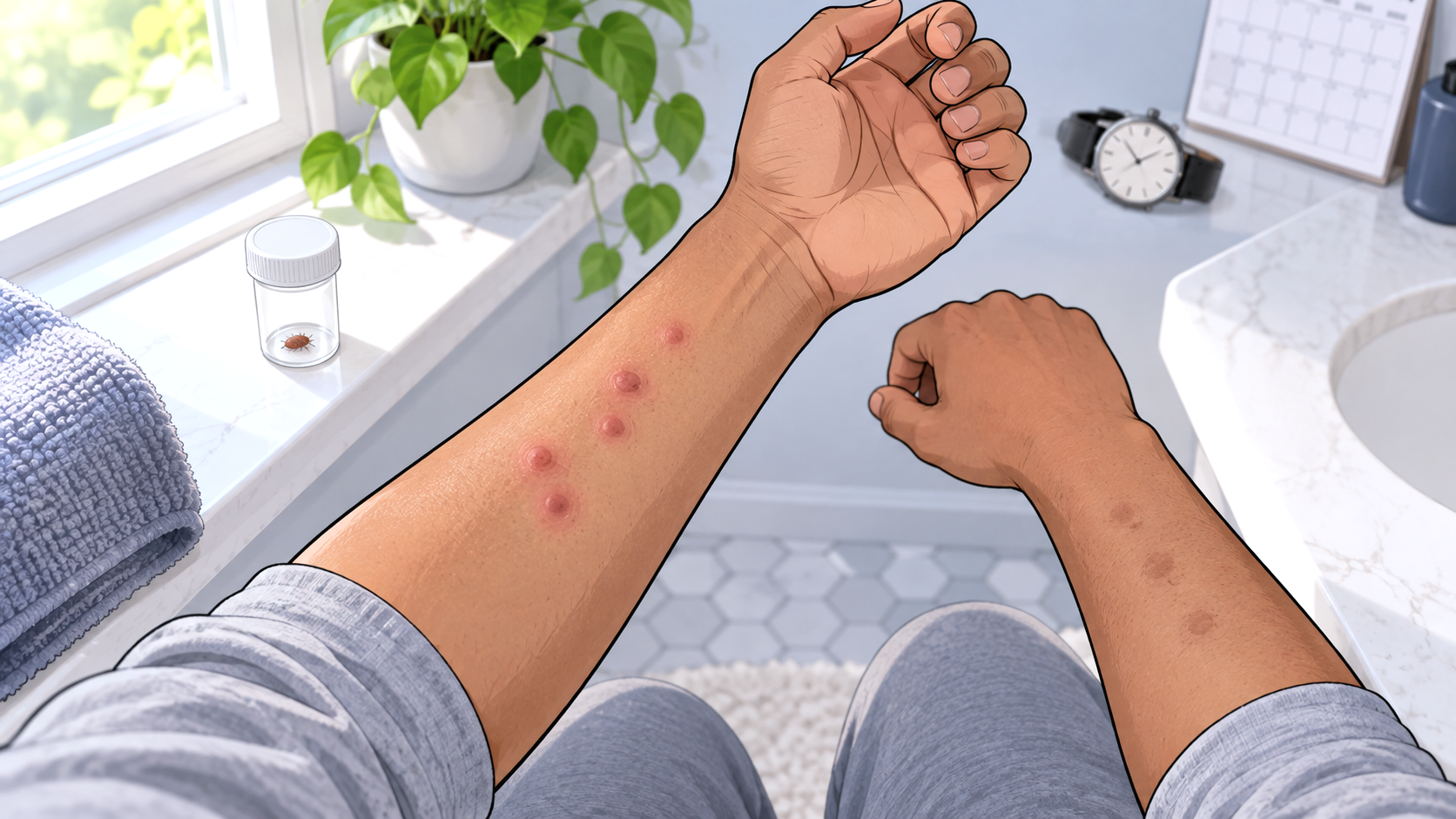
Most bed bug bite reactions fade within about one to two weeks, although some uncomplicated marks disappear sooner. Others can remain visible for several weeks, particularly when there is a stronger inflammatory reaction, repeated scratching or a persistent insect-bite reaction such as papular urticaria.
The mark can also outlast the active reaction. After swelling and itching have disappeared, some people are left with a flat area of darker or lighter pigmentation that can remain visible much longer. That residual discoloration doesn’t necessarily mean the bite is still active or that a new bite occurred in the same place.
How Long Do Bed Bug Bites Take to Appear?
Bed bug bites don’t necessarily appear the morning after you were bitten. According to the CDC’s guidance on bed bug bites, most people don’t notice marks until one to several days after the bite, while reactions can take as long as 14 days to develop in some people.
Other people develop reactions much faster. Clinical literature describes responses ranging from relatively rapid reactions in sensitized individuals to substantially delayed reactions following earlier exposures. Some people don’t develop a visible reaction at all.
That variability makes the timing of a skin mark a poor way to determine exactly when exposure occurred. Waking up with a new bump doesn’t prove you were bitten during the previous night, while finding no marks immediately after staying somewhere doesn’t prove that you weren’t exposed.
The same limitation applies when you’re trying to determine whether bed bug bites always itch. Reactions vary considerably between people, so neither itching nor its timing can confirm an infestation by itself.
How Long Does a Bed Bug Bite Take to Heal?
For an uncomplicated reaction, roughly one to two weeks is a reasonable general expectation.
The American Academy of Dermatology says bed bug bites usually heal within one or two weeks, while a clinical review in American Family Physician similarly describes bed bug bite reactions as typically self-limited and resolving within one to two weeks. A review published in JAMA notes that common itchy lesions can resolve within about a week when they aren’t abraded.
That range is more useful than assigning every bite a seven-day lifespan. One person’s marks may disappear within several days, while another person’s remain visible considerably longer. Even bites on the same person don’t necessarily resolve at exactly the same rate.
Appearance also changes during healing. A fresh bed bug bite can look quite different from the flatter, less inflamed mark left as the reaction settles.
Why Can Bed Bug Bites Last for Weeks?
Some insect-bite reactions persist substantially longer than the usual one-to-two-week range.
One example is papular urticaria, a hypersensitivity reaction that can occur following bites from several arthropods, including bed bugs. DermNet notes that individual lesions can remain for days to weeks. New lesions can appear while older ones are clearing, and a new bite can sometimes cause an older lesion to become inflamed again.
This can make an ongoing series of bites particularly confusing. Several visible bumps don’t necessarily represent bites that all occurred on the same night. Some may be newer reactions while others are older lesions that haven’t completely settled.
Scratching can prolong the problem as well. Repeatedly damaging itchy skin can cause additional irritation and increases the risk of secondary bacterial infection. Controlling the urge to scratch is therefore useful for more than comfort, and there are several ways to reduce itching from bed bug bites while the skin heals.
How Long Do Dark Marks From Bed Bug Bites Last?
The bump can disappear before the mark does.
After inflammation settles, some insect bites leave post-inflammatory hyperpigmentation, meaning the affected area becomes darker than the surrounding skin. Hypopigmentation, where the area becomes lighter, can also occur.
DermNet notes that persistent insect-bite reactions can leave post-inflammatory pigmentation or hypopigmented scars, particularly when lesions have been scratched deeply. Its broader dermatology guidance notes that brown discoloration following insect bites can sometimes persist for months.
A flat dark spot that no longer itches, swells or changes therefore isn’t necessarily an active bed bug bite. It may simply be residual pigmentation from inflammation that has already resolved.
That distinction is particularly important on darker skin, where redness may be less obvious and post-inflammatory pigment changes can be more noticeable. The appearance of bed bug bites on dark or Black skin should be considered alongside other symptoms rather than judged solely by redness.
Can Old Bed Bug Bites Become Itchy Again?
They can in some persistent insect-bite reactions.
DermNet notes that with papular urticaria, a new bite can provoke reactivation of older lesions. That means an old spot becoming raised or itchy again doesn’t necessarily prove a bed bug just bit that exact location.
This makes skin marks unreliable for counting bites or reconstructing exactly when feeding occurred. Delayed reactions, persistent lesions and reactivation can all blur the timeline.
If you’re trying to determine whether bed bugs are still present, physical evidence is more useful. Instead of counting bumps, check for bed bugs and their physical signs, including live insects, eggs, shed skins and characteristic fecal spots.
When Is a Bed Bug Bite Taking Too Long to Heal?
A mark lasting longer than two weeks isn’t automatically infected or dangerous. Persistent insect-bite reactions and residual pigmentation can last considerably longer.
What matters more is whether the site is gradually improving or actively getting worse. Increasing pain, warmth, tenderness, expanding redness or pus can point toward a secondary infection of a bed bug bite. The CDC notes that intense scratching can damage the skin and lead to secondary infection.
Severe swelling, extensive blistering or another unusually strong reaction also deserves medical attention. Difficulty breathing or swelling involving the lips, tongue, face or throat requires urgent medical care. More guidance on when symptoms warrant professional assessment is covered in when to see a doctor for bed bug bites.
Questions About How Long Bed Bug Bites Last
Can a bed bug bite disappear in a few days?
Yes. Reactions vary substantially, and some mild marks can fade within several days. A general range of one to two weeks is more useful for uncomplicated bites overall.
Can bed bug bites last for a month?
Some persistent insect-bite reactions can remain for weeks, while discoloration left after the inflammation resolves can last even longer. A mark remaining visible for a month doesn’t necessarily mean the bite itself is still actively inflamed.
Can old bed bug bites look like new bites?
Yes. Older lesions may still be visible when new ones appear, and papular urticaria can involve reactivation of older lesions following new bites. Appearance alone therefore can’t reliably establish when each bite occurred.
Does scratching make bed bug bites last longer?
It can. Scratching repeatedly traumatizes the skin and can contribute to additional inflammation, scabbing and secondary infection, all of which can extend the time before the skin returns to normal.
Do dark marks mean you’re still being bitten?
Not necessarily. A flat dark mark can be post-inflammatory hyperpigmentation left after the original inflammatory reaction has resolved. Look for evidence of current bed bug activity rather than using lingering pigmentation alone to decide whether new bites are occurring.