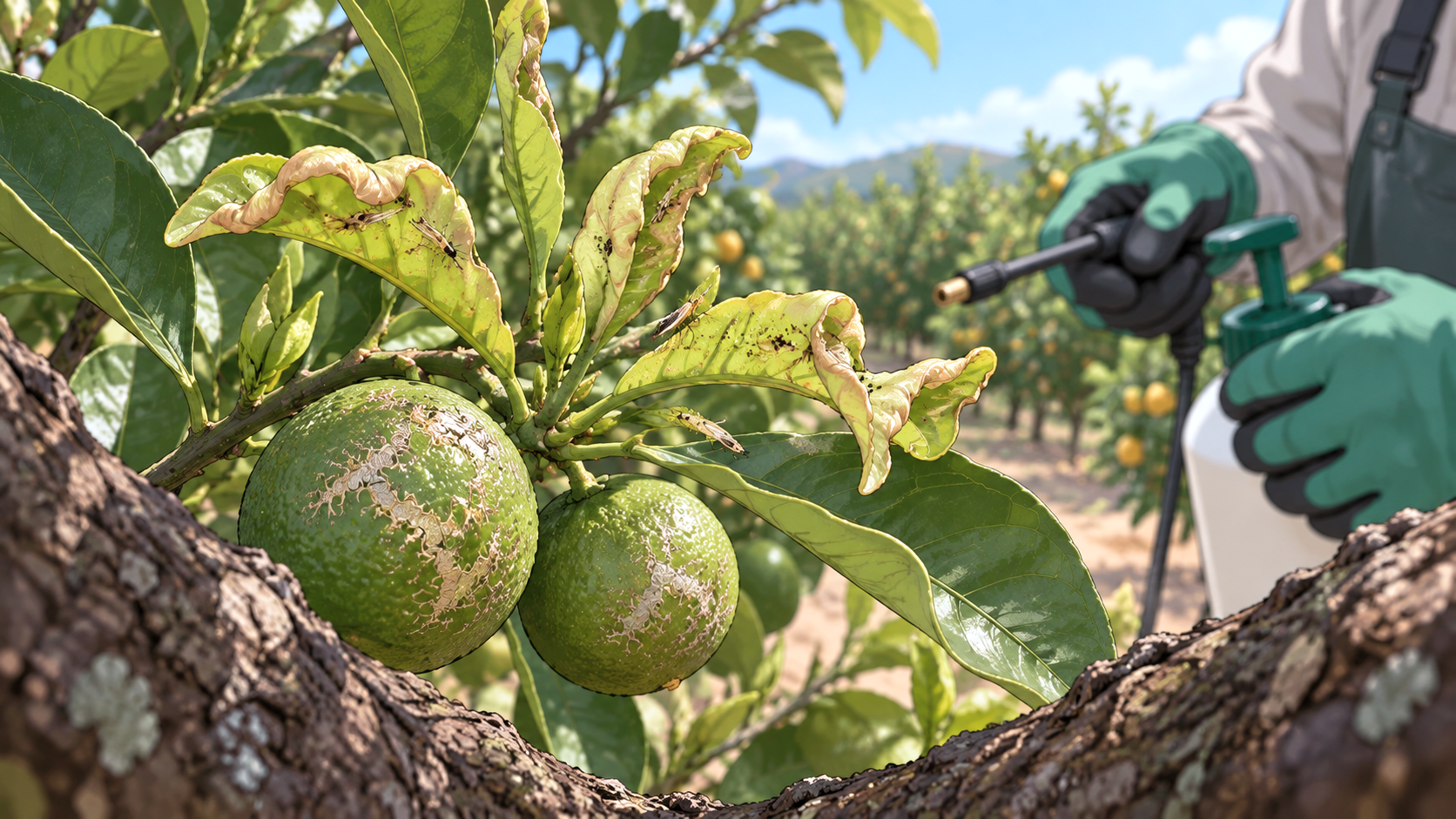
A rough gray or silvery ring around the stem end of an orange or mandarin can begin months before the fruit reaches its final size. The injury happens when tiny citrus thrips feed on very young fruit, often beneath the sepals where they are difficult to notice. As the fruit grows, the damaged rind expands outward and the scar becomes increasingly conspicuous. Tender new leaves can also become distorted, but fruit scarring is usually the damage that attracts the most attention.
Signs of citrus thrips include tiny orange-yellow thrips on tender growth and young fruit, scabby gray or silvery rind scars, a characteristic ring of scarred tissue around the stem end of developing fruit, and distorted young foliage. Fruit is particularly vulnerable shortly after petal fall while it is still small. Although the scars can substantially affect appearance, thrips scarring on citrus is primarily superficial and does not damage the internal quality or flavor of the fruit.
What Do Citrus Thrips Look Like?
Citrus thrips, Scirtothrips citri, are tiny orange-yellow insects with narrow fringed wings as adults. The first immature stage is extremely small, while the second instar is larger, spindle-shaped, wingless, and particularly important because it causes much of the damaging feeding on young citrus fruit. Eggs are inserted into tender leaves, young fruit, or green twigs, which makes them much harder to detect than exposed adults and larvae.
Their size means they can easily be overlooked during a casual inspection. Like other members of the group, citrus thrips have the slender body shape characteristic of thrips, but species-level identification can be more difficult. This matters on citrus because not every thrips found in a flower or on a young fruit is a damaging citrus thrips.
Not Every Thrips on a Citrus Tree Is a Citrus Thrips
Citrus flowers can attract other thrips, including flower thrips that feed on floral material without causing the characteristic citrus fruit damage. Shortly after petal fall, immature flower thrips may still be seen moving around young fruit before they pupate and the adults disperse. Simply finding a tiny thrips on an orange or lemon tree therefore does not prove that it is responsible for rind scarring.
This is one situation where the different species of thrips genuinely matter. When deciding whether control is necessary, concentrate on immature citrus thrips associated with susceptible young fruit rather than assuming every adult found in a blossom is a pest. Unnecessary treatment can disrupt natural enemies without providing a meaningful benefit.
What Does Citrus Thrips Damage Look Like?
The most characteristic fruit damage is shallow, scabby, grayish, or silvery scarring of the rind. Citrus thrips feed by damaging epidermal cells on young fruit. Because the fruit continues growing after the feeding occurs, the original injury expands into a much larger visible scar.
The location of the scar can provide a particularly useful clue. Citrus thrips commonly feed beneath the calyx at the stem end of young fruit, and the resulting injury eventually forms a conspicuous ring around that end of the fruit. Severe scarring can cover a substantial portion of the rind and, in extreme cases, interfere unevenly with fruit expansion enough to alter its shape.
Look for a Ring of Scarred Tissue Around the Stem End
The ring scar is one of the most recognizable signs of citrus thrips injury. Second-instar larvae commonly feed beneath the sepals surrounding the stem end while fruit is very small. Initially, the feeding damage remains close to the calyx and can be difficult to appreciate. As the fruit enlarges, the damaged rind moves outward from beneath the sepals.
Eventually, the result can be a gray, silver, or brownish ring encircling the stem end. The ring pattern around the button helps distinguish citrus thrips injury from several other forms of superficial citrus damage. Wind scarring and feeding by other insects can still create confusing marks, so the shape and location of the injury should be considered alongside evidence of thrips activity earlier in fruit development.
Thrips Can Also Scar the Bottom of Citrus Fruit
Not all citrus thrips damage remains around the stem end. A second form of scarring can develop around the stylar, or blossom, end at the bottom of the fruit. This injury may appear smoother than the rougher calyx-end scar and usually occurs together with stem-end damage rather than appearing by itself.
Stylar-end scarring is particularly associated with mandarins and their relatives, including satsumas and clementines. The difference demonstrates why citrus thrips damage does not look identical across every citrus variety. Fruit type, developmental stage, feeding location, and the amount of thrips activity all influence the final appearance.
Young Citrus Fruit Is Most Vulnerable
Timing makes an enormous difference to the amount of visible damage. Citrus fruit is particularly susceptible from petal fall until it reaches roughly 1.5 inches, or 3.7 centimeters, in diameter. Feeding during this early period can leave scars that become much larger and more conspicuous as the fruit expands.
Older fruit becomes progressively less vulnerable to this characteristic scarring. That is why monitoring and any necessary intervention should focus on the period when young fruit is actually susceptible rather than reacting months later when scars are fully visible. Once the rind has been scarred, spraying the tree cannot erase the damage that has already occurred.
Second-Instar Thrips Cause Much of the Fruit Damage
Not every stage of the citrus thrips life cycle contributes equally to fruit injury. The second-instar larvae are responsible for much of the economically important damage. They actively feed on young fruit, particularly beneath the sepals around the calyx, before progressing into nonfeeding developmental stages.
This is important for monitoring. Seeing adult thrips does not necessarily tell you how much fruit damage is occurring at that moment. Commercial monitoring therefore focuses heavily on finding wingless first- and second-instar thrips on susceptible young fruit rather than simply counting every adult flying around a citrus tree.
Citrus Thrips Can Damage New Leaves
Young citrus foliage can also be attacked. Feeding on tender expanding tissue can cause leaves to curl, distort, or become scarred. New shoots may look noticeably misshapen when thrips populations are high, especially on young trees producing abundant flush growth.
Leaf damage can look alarming without necessarily threatening an established healthy citrus tree. In commercial citrus, healthy trees can often tolerate substantial citrus thrips foliage damage, and treating young nonbearing trees solely to protect foliage generally is not recommended except in severe situations. Repeated pesticide applications for cosmetic leaf injury can create larger pest-management problems by selecting for resistant thrips and killing beneficial arthropods.
Thrips Scarring Does Not Usually Ruin the Inside of the Fruit
A badly scarred orange can look much worse than it actually is. Citrus thrips primarily injure the rind, leaving superficial scabby or silvery scars. The internal fruit can remain normal despite conspicuous external damage.
This distinction is particularly relevant to home gardeners. Commercial citrus can lose value when rind scarring prevents fruit from meeting cosmetic standards, but a backyard grower may have little reason to discard an otherwise sound orange, lemon, or mandarin simply because its peel is scarred. Thrips injury on citrus does not harm the internal quality or flavor of the fruit.
Severe Damage Can Distort Citrus Fruit
Although most attention goes to rind appearance, exceptionally heavy scarring can affect the way a fruit develops. Extensive injury can restrict rind expansion unevenly, producing asymmetrical or misshapen fruit. This is different from the shallow cosmetic scarring seen with lighter infestations.
Fruit deformity has many possible causes, however. Disease, environmental conditions, other pests, and developmental abnormalities can also produce misshapen citrus. Look for the characteristic scabby ring around the calyx and consider whether thrips were present during the susceptible early stage before attributing an oddly shaped mature fruit to thrips.
Citrus Thrips Damage Can Be Confused With Wind Scarring
Fruit growing on the outside of the canopy is exposed to both thrips and environmental injury. Wind can cause leaves, twigs, or neighboring fruit to rub against young citrus, producing scars that may later resemble insect damage. Sunburn and several other rind disorders can add further confusion.
The pattern provides clues. Citrus thrips frequently creates a characteristic ring around the stem end because the larvae feed beneath the calyx when the fruit is young. The position and shape of citrus rind scars can therefore help distinguish thrips injury from wind damage, chewing insects, peelminers, and other causes. Examining young fruit while the pest is still active is more reliable than attempting to diagnose an old scar at harvest.
When Should You Check Citrus Trees for Thrips?
Begin paying close attention around petal fall, when developing fruit enters its vulnerable period. Inspect small green fruit, particularly around the stem end beneath the calyx. A hand lens makes the wingless immature stages much easier to detect.
Continue monitoring while the fruit remains susceptible rather than following a predetermined spray calendar. Citrus thrips abundance can vary dramatically from one year to another, and cool or wet conditions can alter population development. The presence of a few old scars from a previous season provides no reason to assume that the current crop automatically requires treatment.
Check Under the Calyx of Young Fruit
The most useful place to inspect is also one of the easiest to overlook. Examine the stem end of small developing fruit and look beneath the calyx, where immature citrus thrips commonly feed. The insects can be extremely small, so magnification is helpful.
Finding wingless first- or second-instar thrips on susceptible fruit is more meaningful than finding a random winged adult somewhere in the canopy. Adults can move between plants, while harmless flower thrips may also occur around citrus. Matching the appropriate immature thrips with young fruit during the vulnerable period provides much stronger evidence of a damaging population.
Sticky Traps Are Not Enough to Decide Whether Treatment Is Needed
Blue or bright yellow sticky traps can detect flying adult thrips and are useful for monitoring thrips generally. However, they cannot show how many damaging larvae are feeding beneath the calyx of young citrus fruit. Adults caught on a trap may also include thrips species that are not causing the fruit damage you are trying to prevent.
Direct inspection of susceptible fruit is therefore more useful for citrus thrips management. The difference reflects a broader limitation of sticky traps. Because only adult thrips can fly, traps leave the wingless feeding stages unmeasured even though those stages can be responsible for important crop damage.
Natural Enemies Help Keep Citrus Thrips in Check
Citrus trees support several predators that feed on thrips. Predatory mites, minute pirate bugs, lacewings, spiders, and dustywings can all contribute to biological control. Protecting this community can help suppress citrus thrips and reduce dependence on insecticides.
Broad-spectrum pesticide applications can work against that goal. Some products kill beneficial mites and insects that would otherwise contribute to thrips suppression. Citrus thrips populations can actually become more problematic in orchards repeatedly treated with disruptive broad-spectrum insecticides, partly because natural enemies are reduced. Preserving predators is therefore a practical component of control rather than simply an environmental preference.
Avoid Spraying Citrus Trees Just for Damaged Leaves
A citrus tree with curled or scarred new foliage may still be perfectly capable of healthy growth. Established trees can tolerate considerable cosmetic leaf injury, and protecting every imperfect leaf is not necessarily worth the ecological cost of repeated pesticide use.
The greater concern is protecting susceptible young fruit when damaging immature citrus thrips are actually present. This distinction also reduces resistance pressure. Citrus thrips has a documented history of developing resistance when insecticides with the same modes of action are used repeatedly, making unnecessary spraying particularly counterproductive.
Remove Obviously Damaged Plant Material Only When Useful
Pruning can remove badly declining or heavily infested shoots, but a citrus tree should not be stripped of foliage simply because leaves show old feeding scars. Damaged tissue cannot return to its original appearance, yet leaves with substantial healthy green tissue can continue contributing to the tree.
The same principle applies to fruit. A scarred fruit does not need to be removed solely because its rind looks rough. The injury has already occurred, and removing mature scarred fruit does nothing to reverse that earlier feeding. Management should concentrate on active thrips populations and the next vulnerable flush or fruit-development period.
Avoid Excessive Nitrogen
Citrus thrips favor tender new plant tissue, so continually stimulating lush flush growth can provide additional feeding and egg-laying sites. Citrus trees still require adequate nutrition, but excessive nitrogen should not be used in an attempt to make a thrips-damaged tree recover faster.
Follow an appropriate citrus fertilization program based on the tree’s age, growing conditions, and nutritional needs. The goal is steady healthy growth rather than an unnecessary abundance of succulent shoots. Good irrigation and general tree care also improve the tree’s ability to tolerate limited pest injury.
Do Horticultural Oils or Insecticidal Soaps Kill Citrus Thrips?
Horticultural oils and insecticidal soaps can suppress exposed thrips in some home-garden situations when the specific product is labeled for citrus and the target pest. These contact treatments require good coverage and are less effective against protected eggs and insects concealed beneath plant structures. Their suitability also depends on temperature, tree condition, product formulation, and label restrictions.
Do not assume that household dish soap is equivalent to a registered insecticidal soap. Homemade mixtures can injure foliage and lack the tested directions supplied with a labeled pesticide product. If a contact treatment is considered, use a product labeled for the particular citrus tree and application site and follow its directions precisely.
Spinosad Can Be Used Against Thrips in Some Situations
Spinosad is one of the active ingredients used in citrus thrips management, including in some organically managed production systems when an approved formulation is used. However, the presence of spinosad in a product does not automatically mean that product is appropriate for every citrus tree or location. Registration, crop uses, application rates, and harvest restrictions differ among products and jurisdictions.
Repeated use also deserves caution. Citrus thrips has demonstrated the ability to develop resistance to insecticides, including resistance problems associated with repeatedly used modes of action. Any pesticide program should therefore minimize unnecessary applications and follow resistance-management directions on the label rather than repeatedly using one product whenever a thrips is seen.
Timing Matters More Than Spraying Old Damage
A pesticide application cannot remove a ring scar from a fruit that was damaged weeks or months earlier. By the time the scar becomes obvious, the fruit may already be past its most vulnerable stage. Spraying at that point solely because the rind looks damaged provides little benefit against the injury that has already occurred.
Control efforts should instead coincide with damaging immature thrips on young susceptible fruit. Fruit is most vulnerable from petal fall until roughly 1.5 inches in diameter. Monitoring during that period makes it possible to respond to the pest that is currently present rather than treating historical evidence.
Different Citrus Varieties Have Different Levels of Risk
Citrus thrips can affect all citrus varieties, but damage pressure is not equal among them. Navel oranges can be particularly susceptible, while Valencia oranges are generally less susceptible and often require less intervention in commercial production. Satsuma mandarins and certain other citrus can also experience economically important scarring.
Local climate and citrus-growing region matter as well. The significance of Scirtothrips citri and the treatment thresholds developed for commercial orchards in California should not automatically be transferred to every backyard citrus tree in another region. A home gardener should focus on identifying the pest, monitoring actual damage, and following locally appropriate recommendations and pesticide labels.
Why Repeated Broad-Spectrum Spraying Can Make Things Worse
Killing every insect in a citrus canopy is not an effective long-term thrips strategy. Broad-spectrum pesticides can remove predatory mites and beneficial insects along with the target pest. Citrus thrips populations can then rebound without the same level of natural biological control.
Resistance adds another problem. Repeated exposure to the same insecticide group favors individuals capable of surviving that chemistry. Over time, the population can become increasingly difficult to control. Combining monitoring, natural enemies, appropriate cultural practices, and selective treatment only when justified is therefore more sustainable than automatically spraying after seeing damaged fruit.
How to Control Thrips on Citrus Trees
Start by determining whether damaging citrus thrips are actually present. Around petal fall, inspect tender growth and small developing fruit, concentrating on the calyx at the stem end. Use magnification to look for wingless immature thrips and continue monitoring while the fruit remains susceptible. Preserve natural enemies, avoid excessive nitrogen, maintain appropriate tree care, and tolerate cosmetic foliage injury when the tree remains healthy.
If immature citrus thrips are present at damaging levels and treatment is warranted, choose a product specifically labeled for thrips on the citrus species being grown and follow the current label exactly. Favor management approaches that minimize harm to natural enemies and avoid unnecessary repeat applications of the same insecticide group. The principles used for controlling thrips effectively are particularly important on citrus because correct timing can prevent new fruit scarring, while treatment applied after old scars become obvious cannot repair the rind.
More Questions About Thrips on Citrus Trees
Can you eat citrus fruit with thrips scars?
Thrips scarring is primarily rind damage and does not normally affect the internal quality or flavor of citrus fruit. A scarred orange, lemon, or mandarin can therefore remain perfectly usable if the fruit is otherwise healthy and has been handled in accordance with any pesticide preharvest restrictions.
Do citrus thrips get inside oranges or lemons?
Citrus thrips primarily damage the external rind of developing fruit. Their characteristic scars result from feeding on young surface tissue, especially around the calyx, rather than from larvae tunneling through and living inside the mature fruit.
Will thrips scars disappear as citrus fruit grows?
No. The scarred tissue expands as the fruit grows and can actually become more conspicuous. Existing damage cannot be repaired by pesticide treatment, so control is aimed at preventing additional feeding while fruit is still vulnerable.
Do citrus thrips attack lemon trees?
Yes. Citrus thrips can occur on lemons as well as oranges, mandarins, and other citrus. The severity and type of damage vary with cultivar, growing region, pest abundance, and fruit development.
Should every citrus tree with thrips be sprayed?
No. Thrips numbers fluctuate, harmless flower thrips can occur around citrus, and established trees can tolerate considerable foliage damage. Treatment decisions should be based on correctly identifying damaging thrips and finding susceptible fruit at risk rather than the mere presence of a few adults.