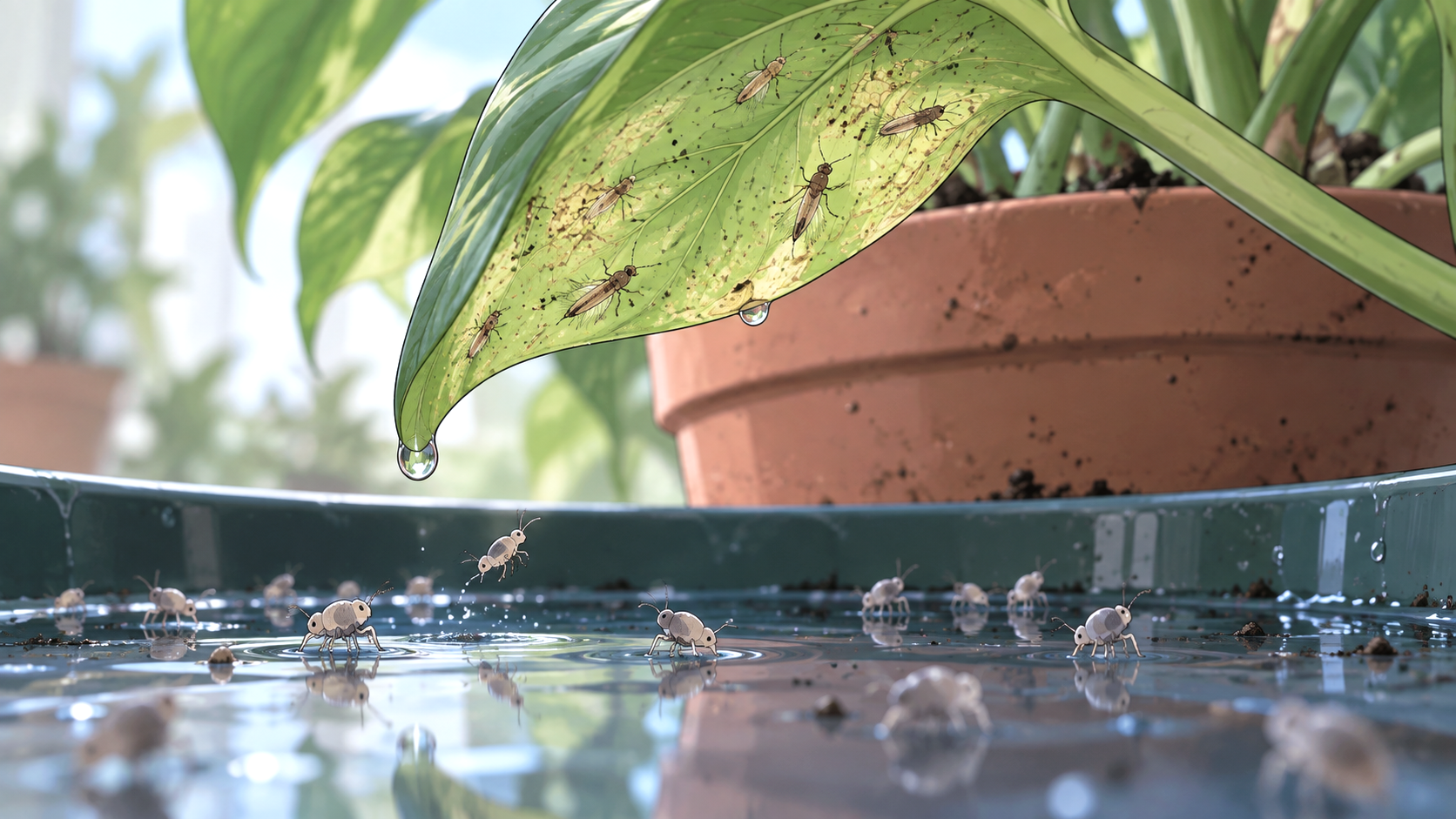
A tiny bug disappears from a leaf the instant you disturb it. Did it fly away, or did it launch itself into the air? That small difference can help separate two arthropods that are easy to confuse at first glance. Thrips are slender insects that commonly feed on living plant tissue, while springtails are wingless, moisture-loving arthropods that mostly consume fungi, algae, decaying plant material, and other organic matter. Most springtails can also jump using a specialized appendage called a furcula. Thrips cannot jump in this way.
Location provides another strong clue. Thrips are commonly found on leaves, flowers, buds, and tender growth, where plant-feeding species can cause visible injury. Springtails are much more strongly associated with damp soil, potting mix, leaf litter, mulch, decaying wood, and other moist environments. A narrow insect crawling through a damaged flower is more consistent with thrips, while large numbers of tiny bugs springing from damp potting mix strongly suggest springtails.
What Is the Main Difference Between Thrips and Springtails?
Movement is often the quickest practical difference. Most springtails possess a forked structure called a furcula tucked beneath the abdomen. When the animal is disturbed, the furcula snaps downward and propels it through the air. A springtail can therefore appear to vanish almost instantaneously. The springtail furcula can launch these tiny arthropods several inches, an impressive distance for an animal only around 1/16 inch long.
Thrips do not have a furcula. They move by walking, and winged adults can fly. Their bodies are also generally narrower and more elongated than the compact forms of many common springtails. Adult thrips can be distinguished further by the extremely narrow fringed wings characteristic of the group. Therefore, a bug repeatedly springing away when touched points strongly toward a springtail, while an elongated insect running across foliage or taking flight may be a thrips.
What Do Thrips Look Like Compared With Springtails?
Thrips frequently resemble tiny moving lines. Their bodies are elongated, narrow, and generally around a millimeter or two long in many familiar pest species, although size varies considerably. Adults of most common species have narrow wings edged with long microscopic hairs. Immature thrips are wingless and often paler, which can make them harder to distinguish from other tiny arthropods. The characteristic slender body and fringed adult wings of thrips become much easier to recognize with a hand lens.
Springtails show greater variation in body shape. Some are relatively elongated, which creates the greatest potential for confusion with thrips, while others have more rounded or globular bodies. Common springtails are minute, wingless, and may be whitish, bluish, gray, or nearly black. Their antennae are visible, and most have the furcula folded beneath the abdomen. Unlike an adult thrips, a springtail will never develop functional wings.
Are Springtails Smaller Than Thrips?
Both are tiny enough that size alone is a poor identification method. Springtails are commonly around 1/16 inch long, although different species vary. Many familiar thrips fall within a similarly tiny size range, with common plant-feeding species frequently measuring around 0.5 to 1.5 millimeters. Some thrips grow larger, and some springtails are smaller than the commonly encountered indoor species.
Their proportions and behavior are more useful than an estimated measurement. A thrips generally looks remarkably thin for its length, producing the characteristic sliverlike appearance described when examining how big thrips actually are. An elongated springtail may initially look similar, but repeated jumping provides a powerful additional clue. If the specimen stays still long enough for magnification, wings or a furcula can provide an even stronger distinction.
Do Springtails Have Wings?
Springtails are wingless throughout their lives. They do not develop wings as adults and cannot fly under their own power. Their ability to suddenly disappear when disturbed comes primarily from jumping rather than flight. This distinction is particularly useful because a springtail’s leap can be so fast that someone watching without magnification may reasonably assume the animal flew away.
Adult thrips of many species do have functional wings. Their four wings are exceptionally narrow and fringed with long hairs, making them look quite different from the broad wings of flies and many other insects. Adult thrips can use these fringed wings to fly and disperse between plants, although air currents also contribute substantially to their movement. Immature thrips remain wingless, so the absence of wings alone does not separate a young thrips from a springtail.
Can Thrips Jump Like Springtails?
Thrips do not have the spring-loaded furcula that gives springtails their name. They can move quickly across plant surfaces, and adults can suddenly take flight, but this is mechanically different from a springtail launching itself into the air. If a tiny wingless arthropod repeatedly jumps when you touch or approach it, springtails become a much stronger possibility.
There is an important exception on the springtail side. Although jumping is characteristic of the group, not every springtail species possesses a functional furcula. Protaphorura fimata, for example, lacks a furcula and curls up instead of jumping when disturbed. Therefore, jumping strongly supports a springtail identification, but failing to see a jump does not eliminate every species of springtail.
What Is the Furcula on a Springtail?
The furcula is a forked appendage located beneath the abdomen. When the springtail is at rest, this structure is held against the underside of the body. When disturbed, it can release the furcula rapidly against the surface below, propelling the springtail away from danger. The animal does not need wings to become airborne.
This mechanism also explains why springtails can seem to disappear before you get a good look at them. Their jump is a rapid escape response rather than sustained flight, and they have limited control over exactly where they land compared with a flying insect. Thrips have no comparable abdominal launching structure. If magnification reveals a furcula on an unknown specimen, that feature separates it decisively from a thrips.
Where Do Springtails Live Compared With Thrips?
Moisture defines springtail habitat more strongly than almost any visible characteristic. Springtails commonly inhabit soil, compost, leaf litter, organic mulch, decaying wood, and other damp places rich in microorganisms and decomposing organic material. Indoors, they may appear in houseplant pots, bathrooms, basements, sinks, drains, and other humid locations. Their continued presence indoors generally indicates a source of moisture.
Plant-feeding thrips spend much more of their active feeding period directly on living plant tissue. Depending on species, they may occupy leaves, flowers, buds, fruit, tender shoots, or protected spaces within distorted foliage. Some thrips do enter soil or leaf litter during their nonfeeding prepupal and pupal stages, so finding a thrips developmental stage near soil is possible. However, the overall thrips life cycle is fundamentally different from the moisture-dependent lifestyle of springtails.
Why Are Springtails in Houseplant Soil?
Damp potting mix can provide springtails with moisture, organic material, fungi, algae, and microorganisms suitable for feeding. Consistently wet growing media can support especially noticeable populations. This explains why someone may water a houseplant and suddenly discover numerous tiny arthropods moving or jumping across the surface.
Their presence does not automatically mean the plant itself is being eaten. Most springtails are scavengers and decomposers rather than significant plant pests. They primarily consume fungi, molds, algae, and decaying plant material. A large population can instead be a useful sign that the growing medium is remaining moist enough to support them. The appropriate response is therefore very different from finding a confirmed population of plant-feeding thrips damaging leaves or flowers.
Do Thrips Live in Potting Soil Too?
Thrips can occur around potting soil, but their relationship with it is not the same as a springtail’s. The two actively feeding immature thrips stages generally develop on suitable plant tissue. In some species, mature larvae subsequently leave the feeding site and enter soil, leaf litter, or another protected location to pass through the nonfeeding prepupal and pupal stages. Adults later emerge and return to suitable plants.
That distinction prevents a common identification mistake. Seeing a tiny arthropod in potting mix does not automatically make it a springtail, but a large population living persistently in damp organic media fits springtail biology particularly well. Finding narrow insects feeding on foliage, flowers, or tender growth and causing recognizable signs of a thrips infestation shifts the evidence toward thrips.
Do Springtails Damage Houseplants?
Most springtails cause little or no meaningful injury to established plants. Their usual foods are decaying vegetation, fungi, molds, algae, and other organic material. In fact, their role in breaking down organic matter can make them part of the normal decomposer community in soil. Seeing them in a plant pot therefore does not justify assuming that they are responsible for every yellow leaf or declining stem.
There are exceptions. Some springtail species can feed on living plant material, and high populations can damage germinating seeds, roots, or young seedlings. The plant injury associated with certain springtails can include tiny rounded pits on young leaves or roots and irregular holes in thin leaves. Mature plants are generally not significantly injured. This makes serious springtail damage quite different from the direct feeding injury that pest thrips can produce on many established plants.
What Does Thrips Damage Look Like Compared With Springtail Damage?
Thrips are much more likely to produce conspicuous aboveground feeding injury on an established plant. Depending on the species and feeding site, affected tissue can develop pale stippling, silvery or grayish scarring, streaks, discoloration, distorted growth, or damaged flowers. Small dark fecal deposits may also appear around feeding areas. Because thrips can feed on young tissue before it expands, some distortion becomes more obvious only as the plant continues growing.
Springtails generally do not produce that pattern. Most species are feeding on decomposing material and microorganisms rather than scraping established foliage. The relatively small number capable of plant injury are more important around seedlings and young plant tissue, where feeding can create pits or irregular holes. Therefore, silvery scarring on mature foliage accompanied by elongated insects is far more consistent with thrips than with ordinary springtails living in the potting medium.
Do Springtails Leave Black Spots on Leaves?
Black fecal spots on damaged foliage are not a defining sign of springtails. Thrips, however, commonly leave tiny dark or shiny fecal deposits near feeding sites. When those dots occur alongside narrow insects and characteristic plant scarring, they become useful supporting evidence for a thrips identification.
Springtails may crawl onto foliage, particularly when conditions are damp, but their presence on a leaf does not prove they caused the surrounding symptoms. If the plant has damage, inspect it for the pest itself and consider the exact pattern of injury. A springtail that jumped onto a leaf from damp potting mix may simply be passing through, while a feeding thrips population can remain closely associated with the damaged tissue.
What Do Young Thrips Look Like Compared With Young Springtails?
Immature thrips are wingless and frequently pale, which is one reason they can be confused with light-colored springtails. The first two feeding stages have elongated bodies, six legs, and antennae. They actively move across plant tissue and can be translucent white, cream, yellowish, or orange-yellow depending on species and age. The appearance changes again as the insect progresses through the larval and nymphal stages of thrips.
Young springtails resemble smaller versions of adults rather than passing through a thrips-like sequence of feeding larvae followed by prepupal and pupal stages. Springtail immatures are commonly whitish, and their appearance changes relatively little apart from size and sometimes color as they mature. Both young springtails and young thrips may therefore be pale and wingless, making location, body shape, behavior, and magnification particularly valuable when distinguishing them.
Do Springtails Have a Larval Stage?
Springtails do not undergo a larval and pupal transformation like many familiar insects. The young hatch looking broadly similar to small adults and increase in size through successive molts. UC IPM notes that immature springtails generally differ from adults mainly in size and color. Adults continue molting after reaching sexual maturity, another unusual feature of their development.
Thrips follow a different sequence. Their eggs hatch into two actively feeding immature stages, followed by nonfeeding prepupal and pupal stages before adulthood. Adults of winged forms then possess the narrow fringed wings absent from the feeding immatures. The developmental difference provides another reason why a mixed group of springtails often looks more uniform than a thrips population containing larvae, later immature stages, and winged adults.
Can Springtails Be White Like Thrips Larvae?
Yes. Pale coloration creates one of the more believable opportunities for confusion. Young springtails are commonly whitish, and adults of some species can also be white or very lightly colored. Thrips larvae can likewise be translucent white, cream, or pale yellow. Looking at color alone could therefore lead to either identification.
Behavior and location provide better evidence. Pale insects jumping from damp soil are highly suggestive of springtails, while narrow pale insects actively feeding in flowers or across damaged foliage are more consistent with immature thrips. If the specimen is large enough to examine with a hand lens, look at its proportions and movement rather than trying to decide whether its exact shade is white, cream, or yellow.
Can Springtails Fly Around the House?
No. Springtails have no wings and cannot fly. They can jump, and that rapid movement sometimes creates the impression that they have flown. Indoors, they may also crawl from one damp location to another. Large populations can appear around sinks, bathtubs, basements, plant pots, and other places where sufficient moisture persists.
Adult thrips can genuinely fly. That means a tiny elongated insect seen moving through the air between houseplants could be an adult thrips, whereas a springtail leaving a surface becomes airborne only through jumping or passive movement. Watching what happens after the animal lands can help. A springtail may launch itself again when disturbed, while a thrips can walk over the plant or use its wings for another flight.
Why Are Springtails Around a Sink or Bathtub?
Bathrooms, sinks, drains, and similar locations offer the moisture springtails need. Individuals entering a house may crawl in search of damp conditions and become trapped in smooth-sided sinks or bathtubs. Their appearance in these locations can be alarming, particularly when dozens or hundreds become visible at once, but springtails do not bite people or pets and do not damage household furnishings.
A recurring indoor population should prompt a search for moisture rather than an assumption that the building has a thrips infestation. Leaks, persistently damp materials, excessive plant-pot moisture, and humid spaces can all create suitable conditions. Reducing the moisture source is central to managing indoor springtails, whereas spraying insects without correcting the damp environment usually provides only temporary relief.
Can Thrips and Springtails Live Around the Same Plant?
Yes. A houseplant can support both at the same time because the two may be using completely different resources. Thrips could be feeding on leaves, flowers, or tender growth while springtails occupy the damp organic potting mix below. Seeing one species therefore does not exclude the other.
This possibility becomes especially important when a plant has visible damage and large numbers of springtails in its pot. It can be tempting to blame the most obvious organisms, even though the springtails may be harmless decomposers. Inspect the damaged foliage separately. If elongated insects, pale thrips larvae, characteristic scarring, and dark fecal spots are present, thrips may be responsible for the plant injury while the springtails simply indicate moist growing conditions.
How to Tell Whether You Have Thrips or Springtails
Movement provides a quick first test. Gently disturb the unknown arthropods without crushing them. Repeated sudden jumps strongly support springtails, particularly when the animals are concentrated around moist potting mix. Next, consider habitat. Large numbers in damp soil, compost, bathrooms, or around decaying organic material fit springtails particularly well.
When thrips are suspected, inspect the living plant instead. Check flowers, buds, tender growth, leaf undersides, and visibly damaged tissue. Gently tapping foliage or flowers over white paper can make tiny arthropods easier to examine. Look for narrow insects rather than compact jumping forms, and use a hand lens to check adults for fringed wings. Several clues pointing in the same direction provide a much stronger identification than relying on size or color alone.
What to Do After You Identify Them
Springtails usually call for moisture management rather than aggressive pest treatment. Check whether houseplant growing media are remaining unnecessarily wet, correct drainage problems, remove excessive decaying organic material where appropriate, and investigate persistent indoor dampness. Springtails that wander indoors can usually be vacuumed or swept up. Insecticides generally provide poor long-term results if the moisture conditions supporting the population remain unchanged.
A confirmed population of plant-feeding thrips requires a different approach because the insects are using living plant tissue. Inspect nearby plants, remove badly infested plant material where appropriate, and consider cultural, physical, biological, and targeted treatment options according to the severity of the infestation. Identifying the affected stages also matters because eggs may be concealed within plant tissue while some later immature stages occupy protected locations. A broader approach to getting rid of thrips can then be matched to the pest you actually found rather than treating harmless springtails by mistake.
More Questions About Thrips and Springtails
Do springtails bite people?
No. Springtails do not bite people or pets. Large numbers indoors can be annoying, but their presence is primarily a nuisance and often points to persistent moisture.
Can springtails crawl on plant leaves?
Yes. Finding a springtail on foliage is possible, especially around plants growing in moist conditions. Its presence on a leaf does not automatically mean it is feeding on or damaging that leaf.
Can thrips and springtails both appear on a white sticky trap?
They can both end up on sticky surfaces, but their presence there should be interpreted carefully. Adult thrips can fly to traps, whereas springtails are wingless and are more likely to reach low traps by crawling or jumping.
Why do springtails suddenly appear in huge numbers?
Suitable moisture and abundant organic material can support large populations. Changes in environmental conditions can also cause springtails to leave their existing habitat and gather in conspicuous locations, making an established population seem to have appeared suddenly.
Are springtails beneficial in soil?
Many springtails contribute to decomposition by feeding on fungi, algae, microorganisms, and decaying organic material. Although a few species can damage seedlings under certain conditions, most are harmless scavengers rather than serious plant pests.