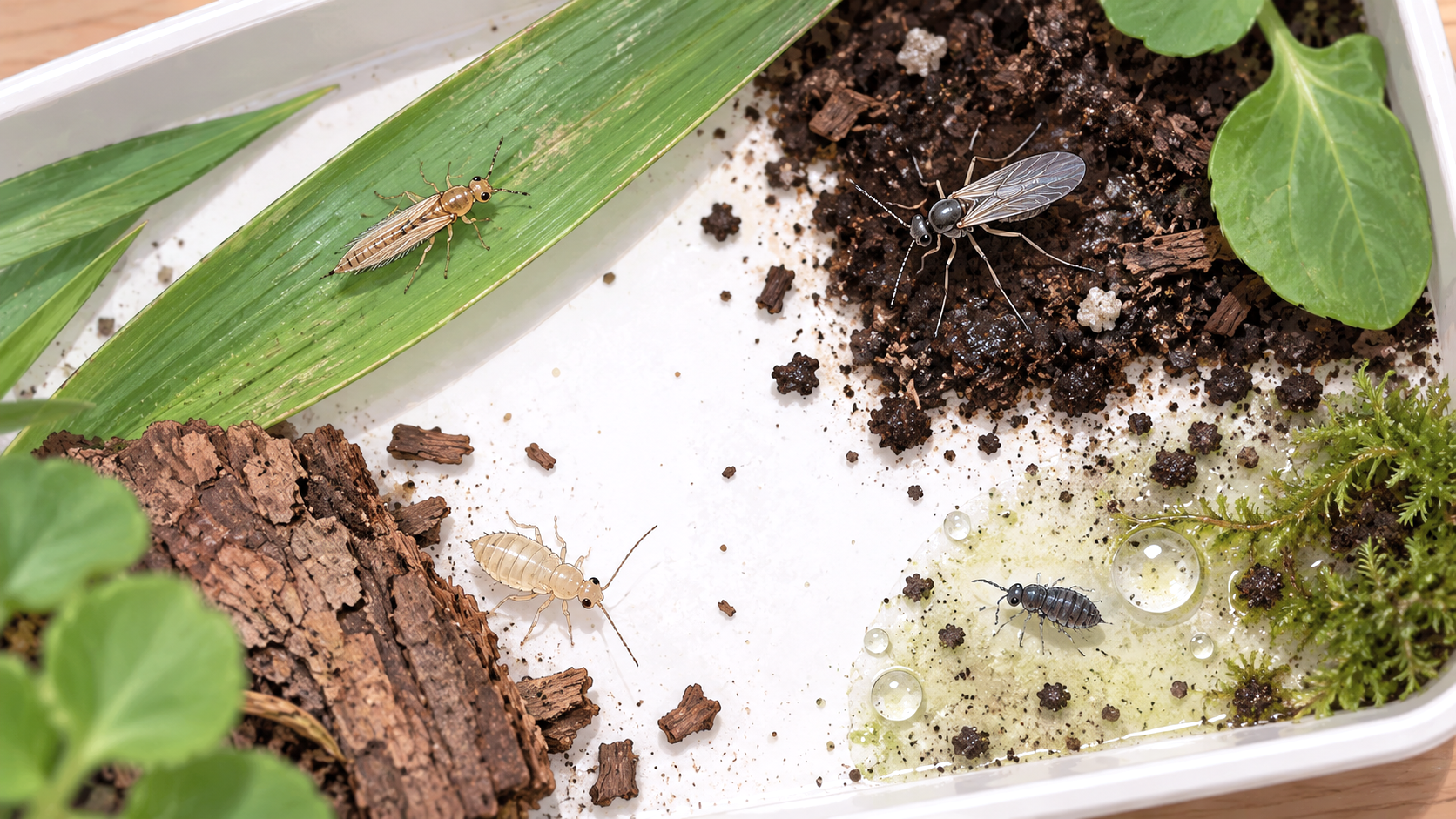
Something tiny and narrow is crawling across a leaf, but that alone does not make it a thrips. Several insects and other arthropods can resemble thrips when viewed without magnification, particularly when they are only one or two millimeters long. Fungus gnats, aphids, spider mites, springtails, booklice, whiteflies, lace bugs, and some tiny predatory bugs can all create confusion under the right circumstances. The fastest way to narrow the possibilities is to look beyond size and color and compare body shape, wings, movement, habitat, and the evidence surrounding the animal.
A genuine adult thrips usually has a slender, elongated body and two pairs of extremely narrow wings fringed with long hairs. Immature thrips are similarly elongated but wingless. Most thrips are less than 1/20 inch long and range from translucent white or yellowish to brown or black. Because those features are difficult to see with the naked eye, the characteristic appearance of thrips becomes much easier to recognize with a hand lens.
What Bugs Are Most Commonly Mistaken for Thrips?
The most plausible lookalike depends heavily on where you found the animal. Around houseplants, fungus gnats, aphids, spider mites, springtails, and whiteflies are among the possibilities worth checking. Outdoors, lace bugs and various tiny plant bugs or predatory insects can add to the confusion. Indoors away from living plants, booklice can resemble pale immature thrips simply because both are extremely small.
Plant symptoms can create additional confusion because different pests sometimes produce superficially similar damage. Thrips, spider mites, and lace bugs, for example, can all cause pale stippling or discoloration on foliage. Identification should therefore begin with the animal itself whenever possible. A 10X hand lens is useful for examining small plant pests, and gently tapping foliage over white paper can make tiny moving specimens much easier to see.
Fungus Gnats Can Be Mistaken for Flying Thrips
Fungus gnats become confusing when the insects are seen flying around houseplants rather than examined at rest. Adults are small, dark flies approximately 1/16 to 1/8 inch long. They have relatively long legs and antennae, clear to grayish wings, and an overall appearance resembling a miniature mosquito. Thrips are much narrower and lack the conspicuously long-legged fly silhouette.
Where the insects concentrate provides an equally useful clue. Fungus gnats are strongly associated with moist, organic growing media because their larvae develop there. Adult gnats commonly walk across potting mix or fly around pots, while thrips are more closely associated with leaves, flowers, buds, and other living plant tissues during their feeding stages. The differences in body shape, larvae, habitat, and plant injury make thrips and fungus gnats relatively easy to separate once you inspect both the insect and the pot.
Aphids Can Resemble Pale or Dark Thrips
Aphids overlap with thrips in both size and color. Depending on species, aphids can be green, yellow, red, brown, gray, or black, while thrips also occur in several pale and dark shades. Color is therefore a poor deciding characteristic. Body shape provides a much stronger distinction because aphids are soft-bodied and broadly pear-shaped rather than narrow and sliverlike.
Look closely at the rear of an aphid and you may see a pair of tubular structures called cornicles. These are characteristic aphid structures that thrips do not possess. Aphids also commonly gather in exposed colonies on stems, leaf undersides, buds, and tender shoots, where their feeding can produce sticky honeydew. The combination of a pear-shaped body, cornicles, colony formation, and honeydew separates aphids from thrips much more reliably than trying to judge whether a tiny insect looks green, yellow, or black.
Spider Mites Can Look Like Tiny Thrips at First
Spider mites are particularly easy to blame when a plant has pale stippling or discoloration because their feeding damage can overlap with thrips injury. The animals themselves are quite different. Spider mites are arachnids rather than insects, and adults have eight legs, oval bodies, no wings, and an extremely small overall size. Thrips have six legs and elongated bodies, while most adults possess narrow fringed wings.
Fine silk provides an especially valuable clue. Webspinning spider mites can produce delicate webbing across leaves and stems, particularly as populations increase. Thrips do not produce this silk. Spider mite eggs are also generally spherical and can occur exposed on leaf surfaces, while many thrips insert their eggs into plant tissue. Examining thrips and spider mites under magnification quickly reveals how different the two look despite the similarity of some plant symptoms.
Springtails Can Be Mistaken for Wingless Thrips
Springtails are tiny, wingless arthropods commonly found in damp soil, potting mix, compost, leaf litter, mulch, and other moisture-rich environments. Some have elongated bodies that can superficially resemble wingless thrips. Their colors also overlap, with springtails occurring in whitish, bluish, gray, and dark forms.
Movement provides one of the quickest distinctions. Most springtails possess a specialized forked appendage called a furcula beneath the abdomen. When disturbed, the furcula propels a springtail suddenly through the air. Thrips do not have this jumping mechanism. Adult thrips can fly, but a wingless arthropod repeatedly launching itself from damp potting soil is far more consistent with a springtail. Habitat, jumping behavior, and plant-feeding patterns provide additional ways to separate springtails from thrips.
Booklice Can Look Like Pale Thrips Indoors
Booklice, or psocids, deserve consideration when tiny pale insects are found indoors rather than feeding on living plants. Common indoor booklice are about 1 to 2 millimeters long, soft-bodied, flattened, and wingless. They can be nearly transparent, tan, gray, brown, or orange-brown. Young individuals can be particularly pale, creating a superficial resemblance to immature thrips.
A closer view reveals different proportions. Booklice have relatively broad heads, with the head wider than the thorax and sometimes nearly as wide as the body. Their bodies are not as uniformly narrow and sliverlike as typical thrips. Habitat is another major clue. Booklice are strongly associated with damp environments and fungal growth, and they may occur around books, paper, stored foods, walls, and other humid areas. They feed primarily on molds, fungi, and related organic material rather than producing the characteristic plant injury associated with pest thrips.
Whiteflies Can Be Confused With Thrips Around Houseplants
Whiteflies and thrips are both tiny plant-feeding insects capable of flying from foliage when disturbed, but their appearance is very different once you get a clear view. Adult whiteflies have powdery white wings that create a broad, mothlike silhouette. Thrips are much narrower and possess thin fringed wings rather than conspicuous white wings covering most of the body.
Their immature stages differ even more. Whitefly nymphs settle on leaf surfaces and become flattened, scalelike forms that barely resemble the flying adults. Thrips larvae remain mobile, elongated insects. Whiteflies also produce honeydew, which can leave foliage sticky and encourage sooty mold. On sticky traps, whiteflies retain their broad white-winged appearance, while thrips are characteristically cigar-shaped and tapered.
Lace Bugs Can Produce Damage That Looks Like Thrips Damage
Lace bugs are less likely to be mistaken for thrips because of body shape than because of what they do to leaves. Adults and nymphs feed primarily on leaf undersides and can cause extensive pale stippling or bleaching visible from above. They also leave dark, varnishlike fecal spots. Thrips can produce both stippling and dark excrement as well, so examining only the damaged leaf surface can lead to confusion.
Adult lace bugs are much larger and broader than most thrips, commonly measuring around 1/8 inch long. Their thorax and forewings have an elaborate network of translucent cells that gives them a lacy appearance. The combination of lace-patterned wings, leaf stippling, and dark excrement makes them distinctive under magnification. If damaged leaves show dark spotting, turn them over and inspect the insects rather than assuming the symptoms prove thrips.
Tiny Predatory Bugs Can Be Mistaken for Thrips
Not every tiny insect moving through flowers is a plant-feeding pest. Minute pirate bugs are small predatory true bugs commonly found in flowers and plant crevices, where they prey on thrips, spider mites, and insect eggs. Their presence near a thrips infestation can make identification especially confusing because predator and prey may occupy the same flower at the same time.
Minute pirate bugs are generally broader and more robust than thrips. Adults have a flattened oval body rather than the exceptionally narrow profile of a thrips. They are also beneficial predators, so mistaking them for plant-feeding insects can work against natural pest suppression. The fact that minute pirate bugs actively prey on thrips and other small arthropods makes careful identification worthwhile before treating every tiny dark insect found among flowers.
Predatory Thrips Can Look Different From Pest Thrips
Sometimes the supposed thrips lookalike actually is a thrips, just not the kind you expected. Predatory species can have body shapes and colors that differ substantially from familiar plant-feeding thrips. This creates another layer of identification difficulty because seeing an unusual red, black, or patterned thrips does not necessarily mean the initial identification was wrong.
Franklinothrips provides a striking example. Older larvae develop a bright red, swollen abdomen and can look like tiny moving red dots without magnification. Adults are mostly black with pale markings. Sixspotted thrips are another beneficial group, with adults bearing three dark blotches on each forewing. These predators feed on mites, pest thrips, and other small arthropods, which is why different species of thrips should not automatically be treated as equally harmful.
How Can You Tell If a Tiny Bug Is Actually a Thrips?
Start with shape rather than color. A typical thrips should be narrow and elongated, sometimes appearing almost like a tiny moving line. An adult examined with sufficient magnification may show two pairs of narrow wings bordered with long hairs. Immature thrips retain the elongated form but lack adult wings. Their colors can range from translucent white and yellowish to dark brown or black, so matching color alone is rarely enough.
Next, consider location and behavior. Plant-feeding thrips are often found on leaves, flowers, buds, growing tips, or other suitable plant tissue. Adult thrips may fly when disturbed, while immature stages remain wingless. A tiny animal repeatedly jumping from damp soil suggests a springtail instead, a mosquito-like fly emerging from potting mix suggests a fungus gnat, and a pear-shaped insect in a sticky colony suggests an aphid. Each additional clue should support the same identification.
Does Plant Damage Prove You Have Thrips?
No single pattern of plant damage proves that thrips are responsible. Spider mites, lace bugs, broad mites, diseases, environmental stress, and other problems can sometimes create symptoms that resemble portions of thrips injury. Even within thrips, different species and host plants can produce different patterns of scarring, discoloration, distortion, and stippling.
This is why the insect and the damage should be considered together. For example, Thrips parvispinus can cause silver scarring, distorted growth, leaf drop, and fruit scarring, but its damage can resemble broad mite injury. Penn State recommends tapping suspected infested plant material over white paper to dislodge the insects for closer examination. Visible signs of a thrips infestation become much more meaningful when actual thrips are also present.
Why Tiny Black Bugs Are Not Automatically Thrips
Dark color is particularly misleading. Some adult thrips are dark brown or black, but so are many unrelated arthropods. Springtails can be dark gray to black, fungus gnats have dark bodies, some aphids are black, and numerous tiny predatory insects are also dark. Calling every tiny black bug a thrips therefore creates plenty of opportunities for misidentification.
The same problem occurs with pale specimens. Immature thrips are often white, cream, or yellowish, but young springtails, booklice, aphids, and several other small arthropods can be similarly pale. The wide range of colors found among thrips makes color useful as supporting evidence only after body structure, habitat, and behavior have been considered.
Use White Paper to Get a Better Look
When a suspected thrips is too small to examine on the plant, place a clean sheet of white paper beneath the foliage or flowers and gently tap or shake the plant. Tiny arthropods that fall onto the contrasting surface become much easier to notice. Watch how they move before trying to collect or crush them. An elongated insect running across the paper may be a thrips, while an arthropod that immediately springs away could be a springtail.
A hand lens can then reveal features that are impossible to see at normal viewing distance. Check the specimen’s overall shape, wings, legs, antennae, and other distinctive structures. The goal is not necessarily to identify an individual thrips to species, which can require microscopic examination of specialized characters. Instead, the first practical question is whether the animal belongs to the thrips group at all.
Check the Plant and the Bug Before Treating Either
Finding a tiny arthropod should lead to identification before treatment. Inspect where it lives, whether it jumps or flies, what its body looks like under magnification, and whether the surrounding plant symptoms match its known feeding behavior. Check flowers and tender growth for thrips, leaf undersides for mites and other plant pests, and moist growing media for springtails or fungus gnats. Several observations that point toward the same pest are far more reliable than a single photograph or color match.
Correct identification can also prevent beneficial or harmless organisms from being killed unnecessarily. Springtails are usually decomposers, many tiny plant bugs are predators, and some thrips themselves prey on other pests. If plant-feeding thrips are confirmed, management can then focus on the actual infestation rather than every small arthropod nearby. The appropriate steps for getting rid of thrips depend on knowing that thrips are genuinely the problem in the first place.
More Questions About Bugs That Look Like Thrips
What tiny bugs look like black lines on plants?
Adult thrips are one possibility because their extremely narrow bodies can look like tiny dark lines. However, other small insects can appear similarly featureless without magnification, so body structure and plant symptoms should be checked before identifying them.
What looks like a thrips but jumps?
An elongated springtail is one possibility. Most springtails use a furcula beneath the abdomen to launch themselves through the air when disturbed, while thrips do not possess this structure.
What looks like a thrips but has a wider head?
Booklice can be extremely small and pale or brownish, but their heads are relatively broad compared with their bodies. Indoor booklice are also associated with moisture and fungal growth rather than feeding damage on living houseplant foliage.
Can beneficial insects be mistaken for thrips?
Yes. Tiny predators such as minute pirate bugs can occur in the same plant areas as thrips, and some species of thrips are themselves predators. Identifying an organism before treating it helps avoid killing beneficial natural enemies.
Can you identify thrips from a photo alone?
A clear magnified photograph may be enough to recognize an insect as a thrips, especially when the elongated body and fringed wings are visible. Identifying the exact species is much more difficult and can require examination of microscopic anatomical characteristics.
One thought on “Bugs That Look Like Thrips: A Quick Identification Guide”