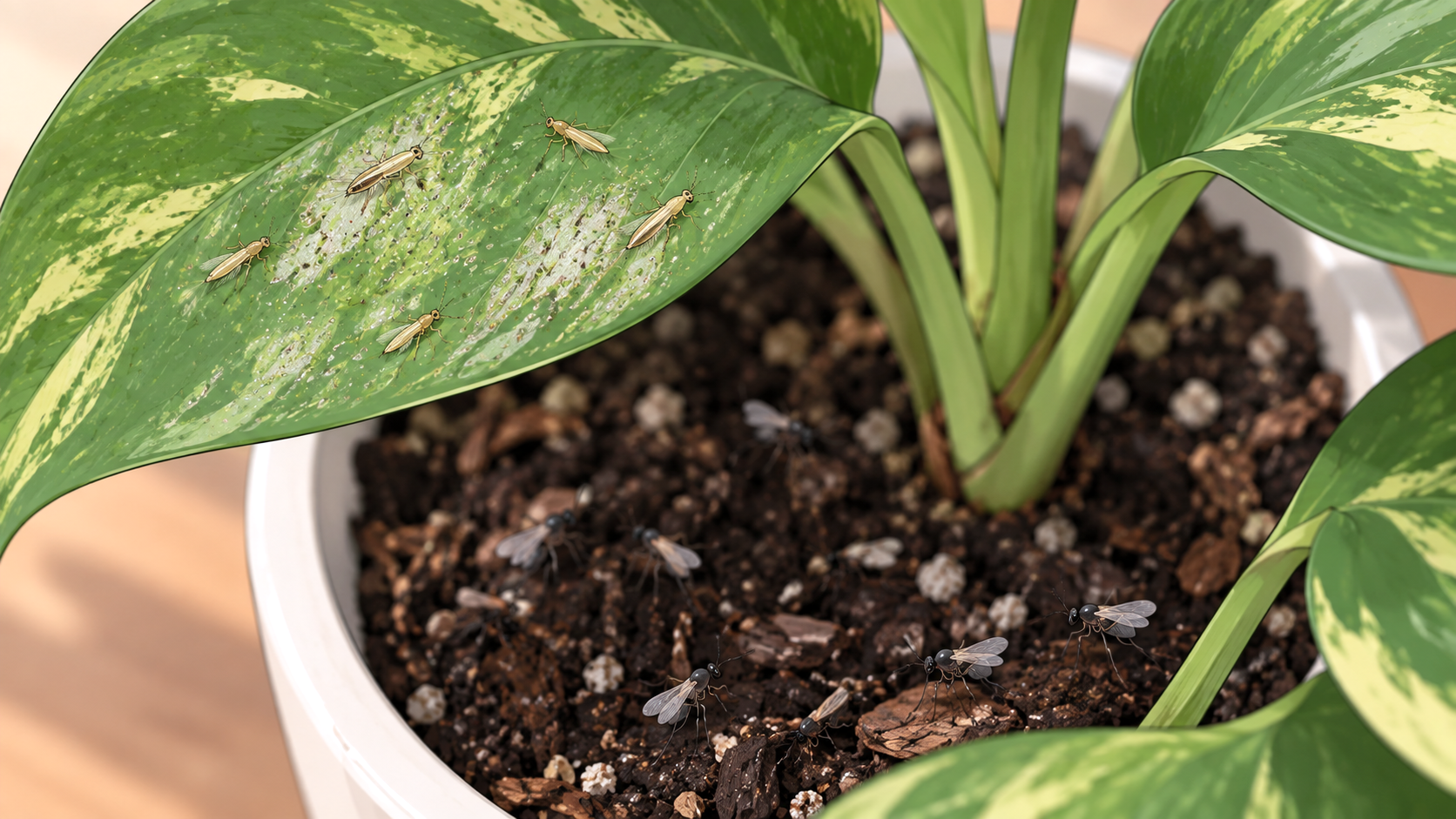
Thrips and fungus gnats are both tiny insects commonly noticed around houseplants, but they look and behave quite differently. Thrips are narrow, elongated insects that usually spend their feeding stages on leaves, flowers, buds, and other plant tissue. Adult fungus gnats look more like miniature mosquitoes, with dark bodies, long legs, long antennae, and clear wings. Their larvae live primarily in moist growing media rather than feeding across the foliage.
Where you repeatedly find the insects is often one of the quickest ways to narrow the identification. Tiny slender insects moving across leaves or hiding in flowers are more consistent with thrips. Small dark flies repeatedly running over potting mix, hovering around pots, or collecting near windows are more consistent with fungus gnats. The distinction matters because the two pests develop in different places and require different management approaches.
What Is the Main Difference Between Thrips and Fungus Gnats?
Thrips belong to the insect order Thysanoptera, while fungus gnats are true flies in the order Diptera. That taxonomic difference is reflected in their appearance. Thrips have narrow bodies, and winged adults have two pairs of extremely narrow wings fringed with long hairs. Fungus gnats have the recognizable proportions of tiny flies, including long slender legs and one pair of functional wings.
Their relationship with the plant is also fundamentally different. Plant-feeding thrips use their mouthparts on leaves, flowers, fruit, buds, and other plant tissues, and their feeding can produce scarring, discoloration, distortion, or silvery areas. Fungus gnat larvae develop in moist organic growing media, where they primarily consume fungi, algae, decaying material, and sometimes plant roots. Adult fungus gnats are primarily nuisance insects and do not feed on or damage houseplants. If you understand those two lifestyles, many confusing sightings become much easier to interpret.
What Do Thrips Look Like Compared With Fungus Gnats?
Thrips look like tiny elongated slivers. Adults are generally less than 3 millimeters long, although exact size varies by species, and their colors range from pale yellow to brown or black. Their bodies are narrow from front to back, and the characteristic fringed wings of adults can be difficult to see without magnification. Immature thrips are wingless and often considerably paler than adults. Our detailed guide to what thrips look like covers those features more closely.
Adult fungus gnats have a noticeably different silhouette. They are delicate, dark, mosquito-like flies with long legs and segmented antennae. Common adults are roughly 1/16 to 1/8 inch long, and their wings range from light gray to clear. Common Bradysia fungus gnats also have a characteristic Y-shaped vein in the wing. Under sufficient magnification, that combination of flylike proportions, long legs, long antennae, and conventional-looking wings is quite different from the extremely narrow body and fringed wings of a thrips.
Are Fungus Gnats Bigger Than Thrips?
There can be some overlap, but an adult fungus gnat often appears larger and much more conspicuously flylike than a typical pest thrips. Common adult fungus gnats are approximately 1/16 to 1/8 inch long, while many familiar thrips are around a millimeter or two long. However, comparing measurements alone is less useful than comparing body proportions because individual species differ in size.
The fungus gnat’s long legs, antennae, and relatively broad wings also make it look larger than its body measurement might suggest. A thrips has almost the opposite visual effect. Its narrow body can make it look like a tiny moving line even when its measured length is not dramatically shorter. Our article on how big thrips are explains that size variation in more detail. When the insect is available for inspection, shape is usually a stronger clue than trying to estimate fractions of a millimeter by eye.
Do Thrips and Fungus Gnats Have the Same Wings?
No. Their wings provide one of the clearest structural differences. Adult thrips typically have two pairs of extremely narrow wings bordered by long microscopic hairs. The fringes give the wings a featherlike appearance under magnification and are characteristic of the insect group. These wings are usually folded over the abdomen while the adult is resting.
Adult fungus gnats are true flies and have one functional pair of wings. Their wings are clear to light gray and look much broader than thrips wings. Common Bradysia fungus gnats have a Y-shaped vein that can help with identification under magnification. If you can see the insect clearly enough to examine its wings, a broad, clear pair on a long-legged mosquito-like insect points toward fungus gnats, while very narrow fringed wings on an elongated insect point toward thrips. Our article on whether thrips can fly explains how those unusual fringed wings function.
Where Will You Find Thrips Compared With Fungus Gnats?
Thrips are usually associated directly with the aboveground parts of their host plants. Depending on the species, they may occur on leaf surfaces, inside flowers, beneath sepals, around buds, within tender growing tips, or inside folded and distorted plant tissue. Many species prefer protected feeding locations, so you can sometimes see the damage before you find the insects themselves. The feeding habits of common plant pest thrips make close inspection of foliage and flowers particularly important.
Fungus gnats are much more strongly associated with the growing medium. Adults commonly run across potting mix or rest around the pot and lower parts of the plant. They may also fly around the room and accumulate near windows because adults are attracted to light. Meanwhile, the larvae remain in moist organic media, commonly in its upper layers. If tiny dark flies consistently rise from the potting mix when you water or disturb a plant, fungus gnats become a much stronger possibility than thrips.
What Do Fungus Gnat Larvae Look Like Compared With Thrips Larvae?
The immature stages are dramatically different once you see them clearly. Thrips larvae or nymphs are tiny insects with legs and antennae. They have elongated bodies, are usually pale, and actively walk across plant tissue while feeding. They resemble simplified wingless thrips rather than maggots. You can see the developmental differences more closely in our article on what thrips larvae and nymphs look like.
Fungus gnat larvae are genuinely wormlike. They have elongated, whitish to transparent, legless bodies and conspicuous shiny black heads. The transparent bodies and black head capsules of fungus gnat larvae make them look completely different from thrips larvae when magnification is sufficient. They also occupy different environments. Fungus gnat larvae live primarily in growing media, whereas feeding thrips larvae are commonly associated with aboveground plant tissues.
Do Thrips Live in Houseplant Soil Like Fungus Gnats?
This comparison requires a little more precision because thrips can have a connection with soil. Many thrips species spend their actively feeding stages on the plant, but mature larvae of some species move into soil, leaf litter, or other protected locations before becoming prepupae and pupae. Those later thrips stages do not feed. Therefore, finding a thrips developmental stage in potting mix is possible, but that does not make thrips biologically equivalent to fungus gnats.
Fungus gnat larvae spend their feeding development in moist growing media. The larvae commonly inhabit the upper few inches of growing medium, where they consume fungi, algae, decaying plant matter, and roots. That soil-centered larval biology is a defining part of a fungus gnat infestation. Thrips, by contrast, have two actively feeding immature stages associated primarily with plant tissue before their later nonfeeding development. The thrips life cycle explains why some thrips temporarily disappear from foliage during that transition.
What Kind of Damage Do Thrips Cause?
Plant-feeding thrips directly injure aboveground plant tissues. Their feeding can produce pale stippling, scarring, distorted growth, and silvery or grayish areas on leaves. Flowers and developing plant tissue can also become damaged. Small dark fecal spots may accompany the feeding injury. The exact symptoms vary with the thrips species and the plant involved, so no single mark should be treated as proof of thrips.
The combination of insects and damage is much more informative. If you find elongated thrips among flowers or leaves and see injury concentrated around those feeding sites, the evidence becomes stronger. If the foliage is damaged but the only insects you can find are mosquito-like flies emerging from wet soil, the visible adults themselves are not causing that leaf scarring. Looking for multiple signs of a thrips infestation is more reliable than diagnosing thrips from one discolored leaf.
What Kind of Damage Do Fungus Gnats Cause?
Adult fungus gnats do not damage plants. They are mainly a nuisance because they fly around pots, windows, lights, and people. The larvae are the stage capable of injuring plants. Although they primarily consume fungi, algae, and decaying organic material, they can also feed on roots and root hairs. Large populations can interfere with plant growth, with young plants and seedlings being particularly vulnerable.
This means fungus gnat damage begins below the foliage rather than with adults scraping or feeding on leaves. High larval populations can contribute to reduced vigor, wilting, or poor growth through root injury. However, these symptoms are not specific to fungus gnats. Overwatering, poor drainage, root disease, and other root problems can produce similar symptoms, and other root-health problems are often more common causes of wilting. Seeing adult gnats near a struggling plant therefore does not automatically prove that fungus gnat larvae caused its decline.
Do Thrips or Fungus Gnats Leave Black Spots?
Both can be associated with dark fecal material, which makes this clue less useful than it might seem. Thrips feeding on foliage can leave small dark or shiny fecal spots around damaged plant tissue. When those spots occur alongside silvery feeding scars and elongated insects on leaves or flowers, they support a thrips identification.
Adult fungus gnats can also leave tiny black fecal deposits on plants and surrounding surfaces. Therefore, black dots alone cannot reliably separate these pests. Location and the accompanying evidence matter. Dark spotting around characteristic thrips feeding injury means something different from tiny deposits around a pot where mosquito-like fungus gnat adults are repeatedly resting. This is a good example of why pest identification works better when several clues agree rather than when one symptom is treated as diagnostic.
Thrips vs. Fungus Gnats on Yellow Sticky Traps
Both adult thrips and fungus gnats can end up on yellow sticky traps, so catching tiny insects on a card does not automatically identify the pest. In fact, UC IPM provides a direct comparison of an adult fungus gnat and a thrips on the same yellow sticky trap. The fungus gnat has the familiar long-legged fly shape, while the thrips appears much narrower and more linear.
A magnifying glass can make that comparison easier. Look beyond the insect’s color and concentrate on proportions. Fungus gnats should look like delicate miniature flies with long legs and relatively broad wings. Thrips should look like narrow slivers, and a sufficiently clear view may reveal their fringed wings. Sticky cards are useful for detecting flying adults, but they do not tell you everything happening on the plant or in the growing medium, so follow the trap inspection with a closer look at both areas.
Does Wet Soil Point to Thrips or Fungus Gnats?
Persistently moist growing medium points much more strongly toward fungus gnats. Females lay their eggs in moist organic material, and the larvae need that environment to develop. Excessive watering and poor drainage can therefore create particularly favorable conditions. Allowing the upper portion of the growing medium to dry between watering, where appropriate for the plant, is one of the most important cultural methods for reducing fungus gnat populations.
Wet soil does not provide the same diagnostic clue for thrips. Thrips populations are more closely tied to suitable host plants, feeding sites, and species-specific environmental conditions. Some thrips use soil during nonfeeding developmental stages, but repeatedly seeing tiny dark flies emerging from persistently damp potting mix is far more characteristic of fungus gnats than of thrips.
Are Thrips or Fungus Gnats More Likely to Fly Around Your Face?
Fungus gnats are more likely to be noticed as obvious tiny flies moving around a room. Adults emerge from growing media and can fly around houseplants, windows, lights, and people. They are weak fliers and generally remain relatively close to the source, but their mosquito-like silhouette and repeated short flights make them noticeable. Importantly, adult fungus gnats do not bite people.
Adult thrips can also fly, but they do not usually create the same recognizable cloud of tiny mosquito-like flies around potting soil. They are much narrower and spend much of their time associated with plant tissue. Air currents can transport thrips, and individual adults may leave plants, so flight alone cannot separate the two pests. The appearance of the flying insect and the place from which it repeatedly emerges provide better clues.
Can a Plant Have Thrips and Fungus Gnats at the Same Time?
Yes. Finding one does not exclude the other because they occupy different ecological niches. A houseplant with suitable foliage for thrips and persistently moist organic growing medium for fungus gnats can support both pests simultaneously. In that situation, you might see narrow thrips and their pale larvae on foliage while dark adult fungus gnats run across the potting mix and fly around the container.
This possibility is worth considering when the evidence seems contradictory. Treating every tiny insect as one pest can lead to confusing results because a measure aimed at fungus gnat larvae in the growing medium will not automatically solve thrips feeding in flowers or foliage. Conversely, concentrating exclusively on leaves will not address fungus gnat larvae developing below. Confirming each insect separately is therefore more useful than forcing every symptom into a single diagnosis.
How to Tell Whether You Have Thrips or Fungus Gnats
Start by watching where the insects spend their time. Repeatedly seeing dark, long-legged, mosquito-like flies on or immediately above moist potting mix strongly suggests fungus gnats. Check the growing medium for their translucent, legless larvae with black heads. A small piece of raw potato placed cut-side down on the growing medium can also be used to monitor for fungus gnat larvae, which may gather beneath it after several days.
For thrips, concentrate your inspection above the soil. Examine flowers, buds, tender new growth, leaf undersides, and other protected plant areas for narrow adults and pale wingless larvae. Gently tapping suitable foliage or flowers over white paper can make dislodged thrips easier to spot. Once you have identified the insect, management becomes much more straightforward because the target is clear rather than simply being “tiny bugs around my plant.”
What to Do After You Identify the Pest
If the insects are fungus gnats, start with the growing medium rather than spraying the foliage unnecessarily. Correct excessive moisture and drainage problems while staying within the watering requirements of the plant. Because the larvae develop in the growing medium, management aimed at that stage can interrupt the population more effectively than repeatedly killing the short-lived adults. Yellow sticky cards can help monitor and reduce adults, but they do not remove the larvae already developing below.
If you confirm thrips, shift your attention to the affected plant tissue and the species or life stages involved. Inspect nearby plants, remove heavily infested plant material where appropriate, and begin with cultural and physical controls before moving to targeted pesticide options when necessary. Our dedicated article on how to get rid of thrips covers that process in detail. Keeping the two pests separate at the identification stage prevents you from treating potting soil for a foliage-feeding problem or repeatedly treating foliage for an insect developing in the growing medium.
More Questions About Thrips and Fungus Gnats
Which pest is more likely to gather around a window?
Adult fungus gnats commonly collect around windows because they are attracted to light. Thrips can also end up around windows, so examine the insect’s body shape before identifying it from location alone.
Can fungus gnat larvae crawl onto plant leaves?
Their normal habitat is moist growing medium, where they feed primarily on fungi, algae, decaying material, and roots. They can also feed on leaves that are resting against the growing-medium surface, but finding active pale insects higher on foliage is more consistent with other pests, including thrips.
Are the tiny flies coming out of potting soil probably thrips?
Repeated emergence of small, dark, mosquito-like flies from moist potting soil is much more characteristic of fungus gnats. Adult thrips can fly, but their feeding stages are primarily associated with plant tissue rather than developing as fly larvae in moist potting mix.
Can yellow sticky traps distinguish thrips from fungus gnats?
The trap itself catches both, but the captured insects can be compared under magnification. Fungus gnats have a long-legged flylike shape, while thrips are much narrower and have fringed wings.
Do fungus gnats turn into thrips?
No. They are completely different insects. Fungus gnat larvae eventually become adult fungus gnats, while immature thrips develop into adult thrips. One can never transform into the other.
One thought on “Thrips vs. Fungus Gnats”