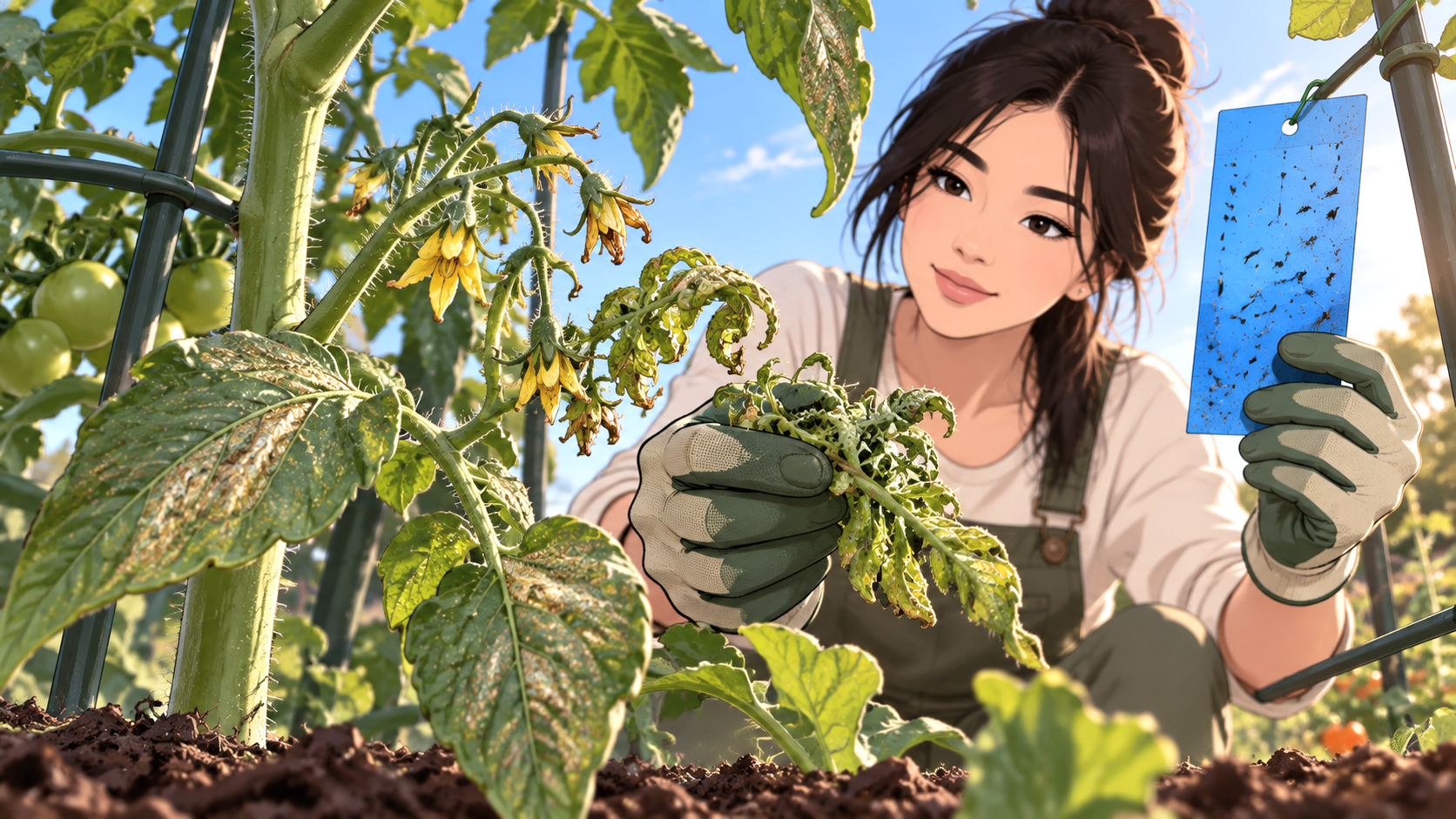
White-to-silvery patches appearing on young tomato leaves can be easy to blame on sun, watering stress, or another small pest. Look more closely and you may find tiny black specks scattered through the damaged areas, distorted flowers, or slender insects moving across tender growth. Those clues deserve attention because thrips can affect tomatoes in two different ways. Large populations can directly damage plant tissue through feeding, while certain thrips can also transmit Tomato spotted wilt virus, a disease that can seriously damage tomato plants.
Thrips on tomato plants are tiny, slender insects that may cause white or silvery leaf patches, black fecal specks, distorted growth, and deformed flowers. Western flower thrips can also transmit Tomato spotted wilt virus to tomatoes. Confirming the insects is important because several tomato problems can produce similar discoloration or distortion, and finding thrips on a plant does not automatically mean they are responsible for every symptom.
What Do Thrips Look Like on Tomato Plants?
Thrips are extremely small and much easier to examine with a hand lens than with the naked eye. Mature western flower thrips are about 1.5 millimeters long, while onion thrips are slightly smaller at about 1.3 millimeters. Adults are slender and possess two pairs of narrow wings fringed with long hairs. Immature thrips have a similar elongated body shape but are lighter in color and lack adult wings. The differences between adult and immature thrips become much clearer under magnification.
On tomatoes, inspect tender foliage, growing points, flowers, and other protected plant structures. Thrips can move quickly, and adults can fly, so a single individual may disappear before you get a close look. Pale larvae are even easier to overlook against light-colored flowers. Instead of searching only for black insects, watch for tiny elongated bodies ranging from pale yellowish shades to brown, depending on species and developmental stage.
What Does Thrips Damage Look Like on Tomato Leaves?
Direct feeding damage can create white-to-silvery patches on emerging tomato leaves. Tiny black fecal specks may occur within these injured areas, producing a particularly useful combination of symptoms. High thrips populations can also distort plant growth and damage developing flowers. These silvery feeding scars and dark fecal deposits are more informative than yellowing alone because many unrelated tomato problems can turn foliage yellow.
The damage does not necessarily cover an entire leaf evenly. A plant may develop scattered pale patches, short scarred areas, stippling, or distorted portions of young foliage. Injured tissue can eventually become brown as it ages. When damage occurs before a leaf fully expands, the resulting scar may become more noticeable as the leaf grows, which helps explain why visible injury sometimes appears more dramatic after the insects have moved elsewhere.
Tiny Black Specks Can Appear Inside Damaged Areas
Dark specks around pale or silvery tissue provide another reason to investigate for thrips. These marks are fecal deposits left around feeding areas. They can resemble tiny pieces of soil or dirt, especially on tomato plants growing outdoors where leaves naturally collect dust and debris.
Try gently rubbing or examining the suspected marks rather than diagnosing them from a distance. When numerous black specks repeatedly occur within fresh silver-white feeding patches and tiny elongated insects are present nearby, the evidence becomes considerably stronger. The same combination of feeding scars and dark excrement can occur on other plants attacked by pest thrips.
New Tomato Growth Can Become Distorted
Thrips feeding is particularly noticeable when it affects developing tissue. High populations can distort tomato growth, and damage that occurs before a leaf expands may become increasingly conspicuous as the tissue grows. New leaves may consequently appear scarred, irregular, or misshapen rather than developing normally.
Distorted tomato foliage should never be attributed to thrips automatically. Viruses, herbicide injury, physiological disorders, mites, and other problems can alter new growth as well. Inspect the plant for the insects themselves and look for accompanying feeding evidence. Finding several pale larvae or adult thrips around fresh silvered tissue provides much better evidence than leaf distortion by itself.
Tomato Flowers Can Be Damaged by Thrips
Thrips are often attracted to flowers, where they can feed within protected structures and on pollen. Heavy populations on tomatoes can deform flowers, potentially affecting normal flower development. Because thrips are so small, several individuals can occupy a blossom without being obvious from the outside.
Gently tapping tomato flowers over white paper can reveal insects hidden inside. Watch for tiny elongated bodies moving across the contrasting surface, then examine them with a hand lens if possible. Finding immature thrips in flowers is particularly useful because it provides evidence that the insects are developing on the plant rather than simply representing occasional adults that arrived from surrounding vegetation.
Thrips Can Spread Tomato Spotted Wilt Virus
Direct feeding is not the only concern. On tomatoes, one of the most important consequences of certain thrips infestations is transmission of Tomato spotted wilt virus (TSWV). Western flower thrips is an important vector. The relationship between the insect and virus is unusual because thrips acquire Tomato spotted wilt virus during their immature feeding stages, while transmission from infected plants to healthy plants primarily occurs after infected thrips become adults.
Once an individual thrips acquires the virus during the appropriate immature stage, it can remain capable of transmitting it for the remainder of its life. The virus is not passed directly from an infected adult female through her eggs to her offspring. This means managing TSWV involves more than simply killing adults already sitting on one tomato plant because the broader cycle involves infected host plants, immature thrips acquiring the virus, and later movement by infectious adults.
What Does Tomato Spotted Wilt Virus Look Like?
TSWV symptoms can vary considerably, and visual symptoms alone cannot provide a definitive diagnosis. Affected tomatoes may become stunted or yellow, and foliage can develop curling, malformed growth, mottling, or areas of dead tissue. Fruit can show uneven ripening and distinctive off-color rings, sometimes accompanied by deformation. However, several tomato viruses and nonviral disorders can produce overlapping symptoms.
That uncertainty matters because plant viruses can require laboratory testing for definitive identification. Finding thrips plus rings or discoloration on a tomato does not by itself prove TSWV. If virus symptoms are suspected, treat the possibility differently from ordinary thrips feeding damage because controlling insects cannot cure a tomato plant that is already infected with a virus.
Killing Thrips Will Not Cure a Tomato Plant With TSWV
There is no pesticide treatment that removes a plant virus from an infected tomato. Once a tomato has a confirmed viral infection, insect control may help reduce further vector activity but cannot restore the infected plant to a virus-free condition. Virus management focuses on preventing spread rather than curing infected plants.
This distinction prevents wasted treatment. Silvery feeding scars caused directly by thrips and systemic symptoms caused by TSWV are different problems even though the same insect can connect them. When a tomato shows suspicious rings, severe stunting, mottling, or other virus-like symptoms, consider diagnostic confirmation rather than repeatedly applying insecticides in an attempt to reverse the disease.
Check Tomato Flowers and Tender Growth for Thrips
Begin your inspection with the newest foliage and flowers. Thrips frequently use buds, flowers, shoot tips, and other protected plant structures. Their tiny size allows them to remain in narrow spaces that are easily missed during ordinary garden maintenance. Turn leaves over as well and examine areas around veins and growing points.
A hand lens makes identification considerably easier. Adult western flower thrips and onion thrips are roughly around 1.3 to 1.5 millimeters long, so distinguishing body features without magnification can be difficult. Their actual size compared with other tiny plant pests explains why growers often notice plant damage before noticing the insects.
Use White Paper to Find Thrips on Tomato Plants
Place a sheet of white or light-colored paper beneath suspicious foliage or flowers and gently tap the plant. Thrips that fall onto the paper become much easier to see than they were against green foliage. Look for tiny elongated insects running across the surface. This technique can reveal both adults and feeding larvae.
White-paper monitoring is especially useful when a tomato has fresh silvering but no obvious pests. Still, do not assume every small arthropod that falls from the plant is a thrips. Aphids, mites, predatory insects, and other organisms can occupy tomatoes. Examine the body shape with magnification before deciding what you found.
Sticky Traps Can Help Monitor Adult Thrips
Bright yellow or blue sticky traps can detect flying adult thrips moving around tomato plants. Because only adults have functional wings, traps primarily provide information about adult activity rather than the entire population. Eggs concealed within plant tissue and wingless immature stages will not be represented accurately by trap catches.
Sticky traps work best as monitoring tools rather than stand-alone control. A trap showing increasing numbers of thrips can prompt closer inspection of flowers and new growth, while declining catches can contribute to evaluating management. The fact that adult thrips can fly and also disperse with air currents means new individuals can arrive even after an earlier population has been reduced.
Keep Weeds Around Tomatoes Under Control
Thrips have a broad host range, and several weeds can contribute to the local thrips and TSWV cycle. Some plants can support both the virus and reproducing thrips, providing a reservoir from which infectious adults later move into tomatoes. Managing weeds therefore has value beyond making the garden look tidy.
Timing matters when removing heavily infested surrounding vegetation because disturbing host plants can encourage adult thrips to move. In larger tomato production systems, management focuses on the crop and surrounding vegetation as part of an integrated strategy rather than treating each tomato plant as an isolated habitat. In a home garden, keeping weeds controlled consistently before they become established around tomatoes is more useful than allowing dense host vegetation to develop beside the crop.
Avoid Excessive Nitrogen Fertilizer
More fertilizer does not necessarily make a thrips-damaged tomato recover faster. Excessive nitrogen can produce abundant tender plant growth and can favor some thrips populations. Tomatoes need adequate nutrition, but applications should match the plant’s actual requirements rather than being increased simply because leaves look damaged.
The same principle applies to watering. Maintain appropriate, consistent irrigation without keeping the root zone unnecessarily saturated. Good plant care cannot eliminate an established thrips population, but unnecessary stress can make it harder for a tomato to tolerate pest injury. Balanced cultural care should therefore form the background of any pest-management program.
Preserve Natural Enemies Around Tomato Plants
Thrips have numerous natural enemies, including minute pirate bugs, predatory mites, lacewings, and other predators. These beneficial arthropods can contribute to suppressing thrips populations, particularly outdoors. Broad-spectrum insecticides may kill those predators and disrupt biological control while also placing selection pressure on the pest population.
This is particularly important with western flower thrips because insecticide resistance is a significant management problem. Repeatedly applying the same pesticide without monitoring the population can reduce effectiveness while harming beneficial organisms. An integrated approach that combines cultural practices, monitoring, natural enemies, and selective treatments when necessary is more sustainable than treating every observed thrips with a broad-spectrum spray.
Remove Seriously Affected or Virus-Suspect Plants When Appropriate
A tomato showing ordinary feeding scars does not automatically need to be removed. If the problem is limited to direct thrips feeding, management can focus on reducing the insects and monitoring new growth. A plant strongly suspected or confirmed to have a virus presents a different issue because it can potentially remain a source of virus for vectors that subsequently move to healthy plants.
When a tomato virus is confirmed, removing infected plants helps prevent them from remaining a disease reservoir. Remove the entire affected plant and dispose of it appropriately rather than expecting insecticides to cure it. When symptoms are uncertain, diagnostic confirmation can prevent a healthy plant suffering from an unrelated problem from being removed unnecessarily.
Can You Spray Thrips on Tomato Plants With Insecticidal Soap?
Insecticidal soaps can suppress exposed thrips when the product is specifically labeled for the intended edible crop and pest, but contact is important. Thrips hidden in flowers, protected plant structures, or other concealed areas can escape treatment, while eggs inserted into plant tissue are also protected. Soap therefore should not be expected to eliminate every developmental stage with one application.
Coverage and product choice matter because tomatoes are food crops. Never substitute household dish detergent for a registered insecticidal soap and assume the two are equivalent. Use only a product whose label permits application to tomatoes and follow all directions concerning concentration, coverage, application frequency, protective equipment, and harvest intervals.
Can You Use Horticultural Oil for Thrips on Tomatoes?
Some horticultural oils can suppress exposed soft-bodied pests, including thrips, when the particular product is labeled for tomatoes and the intended application. Like insecticidal soaps, oils work primarily through direct contact and therefore perform poorly against insects protected deep inside plant tissue or other inaccessible locations.
Plant safety also matters. Oils can injure foliage under unsuitable environmental conditions or when combined too closely with incompatible products. The label determines whether a particular oil can be used on tomatoes, when it can be applied, and what precautions are necessary. Avoid applying a generic homemade oil mixture to an edible crop simply because oil-based treatments are sometimes used against thrips.
Spinosad Can Be an Option for Thrips on Tomatoes
Spinosad is among the insecticides used against thrips, and tomato pest-management programs include spinosad products among available options. However, registration, formulation, permitted uses, rates, and harvest restrictions vary. A product containing an effective active ingredient is not automatically legal or appropriate for every tomato-growing situation.
Thrips can also develop resistance when insecticides with the same mode of action are repeatedly used. Where repeated pesticide applications are necessary, resistance management involves following the product label and rotating appropriate modes of action rather than repeatedly exposing the population to the same insecticide group. Chemical control should remain one part of a broader program rather than the entire strategy.
Avoid Spraying Tomatoes Just Because You Found One Thrips
Finding a thrips does not necessarily mean the tomato is suffering meaningful damage. Thrips occur on many plants, and some species can even be beneficial predators. The number present, species involved, evidence of reproduction, feeding injury, and local virus risk all affect the significance of the finding.
Confirm that pest thrips are associated with fresh damage before escalating treatment. Look for silver-white scars, black fecal specks, distorted flowers or growth, and feeding larvae. The broader range of bugs that can resemble thrips is another reason to inspect tiny insects carefully before choosing a pesticide.
One Treatment May Not Eliminate Thrips
Thrips have several developmental stages, and not all are equally exposed. Many plant-feeding species insert their eggs into plant tissue. After two feeding immature stages, thrips pass through nonfeeding prepupal and pupal stages, which can occur in soil or other protected locations depending on the species. Adults later emerge and can return to suitable host plants.
This egg-to-adult thrips life cycle makes repeated monitoring essential. A spray may kill exposed adults and larvae while leaving protected eggs untouched, allowing new individuals to appear later. If a pesticide label permits or requires repeat applications, follow its specified interval rather than creating an arbitrary spraying schedule.
How to Control Thrips on Tomato Plants
Begin with identification and monitoring rather than spraying immediately. Check flowers and young leaves, tap suspicious plant parts over white paper, and use sticky traps where useful to monitor adults. Keep weeds controlled, maintain appropriate irrigation and fertility, and preserve natural enemies. Remove declining or heavily infested plant material when appropriate, but distinguish direct thrips injury from suspected viral disease before deciding whether an entire tomato plant needs to go.
If damaging populations persist, select a treatment specifically labeled for thrips on tomatoes and use it exactly as directed. Lower-impact contact products can be useful in some home-garden situations, while other registered insecticides may be appropriate depending on location and pest pressure. Because thrips can hide in flowers and other protected structures and have life stages that escape contact treatments, effective thrips control combines monitoring, cultural practices, natural enemies, sanitation, and carefully selected pesticides rather than depending on repeated spraying alone.
More Questions About Thrips on Tomato Plants
Can tomatoes still be eaten after thrips feed on the plant?
Direct thrips feeding on leaves does not automatically make tomato fruit unsafe to eat. Fruit with superficial pest damage may still be usable if otherwise sound, but any pesticide applied to an edible tomato crop must be used according to its label, including the required preharvest interval.
Do thrips live inside tomatoes?
Thrips primarily feed on plant surfaces, flowers, buds, and other suitable tissues rather than living inside ripe tomato fruit as an internal fruit-feeding larva. Feeding can affect developing plant tissue, but finding external thrips damage should not be interpreted as evidence that the inside of every tomato contains thrips.
Can thrips move from peppers to tomato plants?
Yes. Several thrips have broad host ranges, and adult thrips can move between suitable plants. Tomatoes and peppers can both participate in systems involving western flower thrips and Tomato spotted wilt virus, making nearby host plants relevant when monitoring a garden.
Should you remove every tomato leaf damaged by thrips?
No. Lightly scarred leaves can continue contributing to the plant. Removal is more useful for severely declining or heavily infested material, and excessive pruning can unnecessarily reduce healthy foliage.
How do you know whether thrips control is working?
Watch the newest tomato growth rather than waiting for old scars to disappear. Existing feeding damage is permanent. Fewer thrips during repeated inspections, declining adult activity on monitoring traps, and new leaves and flowers developing without fresh silvering or distortion are better signs of improvement.
Pesticide and plant-disease disclaimer: Pesticide registrations, permitted food-crop uses, application rates, and preharvest intervals vary by product and location. Use only products labeled for tomatoes, the target pest, and the intended application site, and follow the current label exactly. Virus-like tomato symptoms cannot be reliably diagnosed from appearance alone; consider professional or laboratory diagnosis when Tomato spotted wilt virus or another plant virus is suspected.