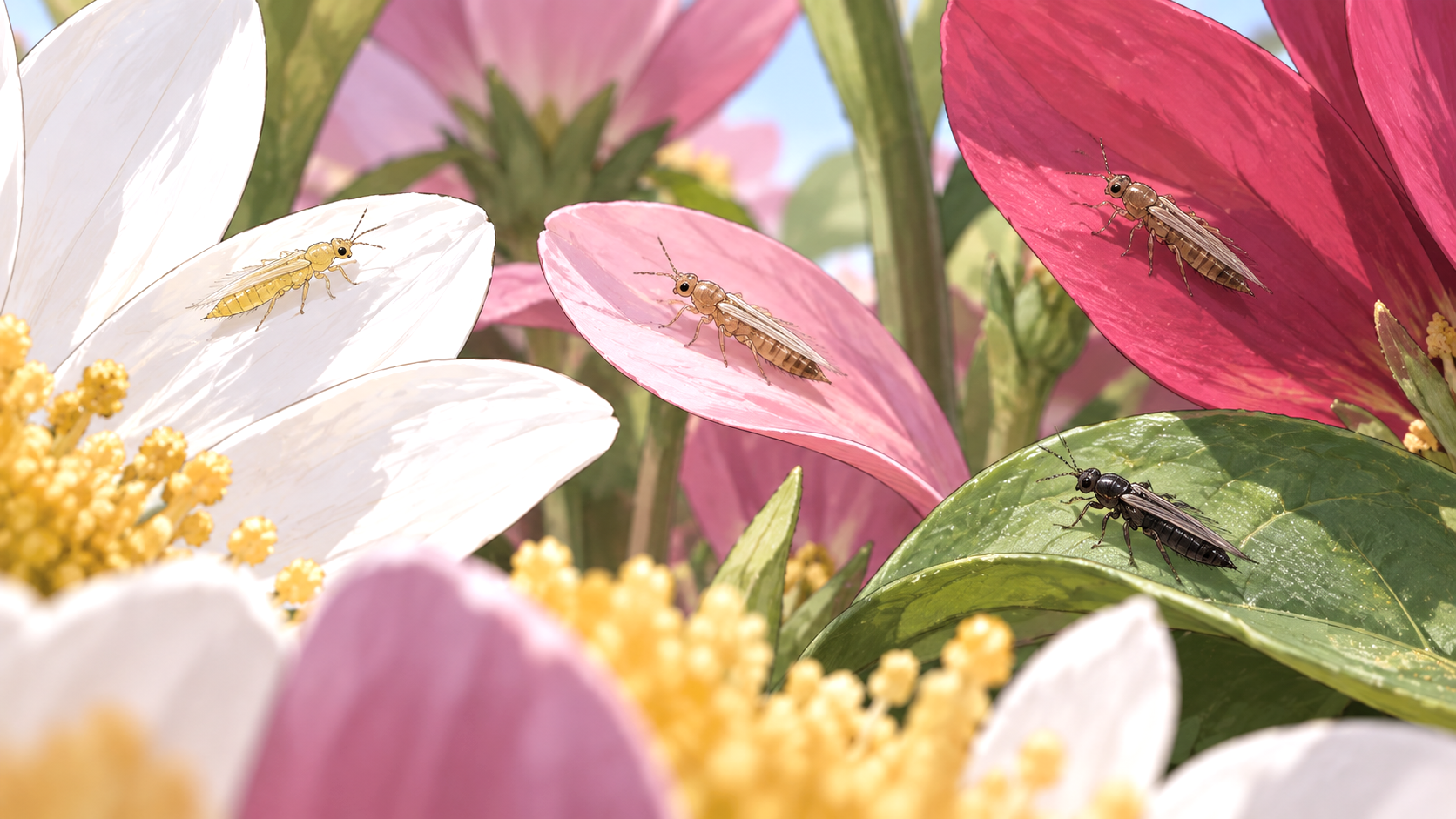
Thrips come in several colors rather than one standard shade. Depending on the species, sex, and life stage, they can appear white, cream, yellow, orange-yellow, tan, brown, dark brown, or black. Some also have contrasting markings or banded wings. Color can help narrow an identification, but body shape and other features matter because several thrips species overlap in color.
That variation explains why two photos of thrips can look surprisingly different. A pale yellow thrips on a flower and a dark brown thrips on a leaf can both belong to the same insect order, Thysanoptera. Even within one species, adults and immature stages may not look exactly alike. If you are trying to identify an insect on a plant, color works best as one part of the picture rather than a stand-alone test.
Are Thrips Usually Yellow, Brown, or Black?
All three colors occur among thrips. Many plant-feeding species fall somewhere between pale yellow and dark brown, while other species can appear almost black. The color variation among common thrips includes yellowish, brown, and black forms, and some species have distinctive markings on their bodies or wings. Consequently, there is no useful rule that says a “real” thrips should be one particular color.
This becomes especially important when you are looking at an insect without magnification. A pale thrips may appear cream or nearly white against a dark leaf, while a brown individual can look almost black in poor lighting. Rather than trying to match an exact shade from an online photograph, first check whether the insect has the narrow body associated with thrips. Our guide to what thrips look like covers those physical characteristics in more detail.
What Color Are Western Flower Thrips?
Western flower thrips (Frankliniella occidentalis) show why color alone can become confusing. Adult females can range from yellow to dark brown, while males are generally yellow. Their coloration can therefore vary enough that two western flower thrips do not necessarily look identical at first glance. The appearance of western flower thrips also overlaps with other small thrips that occur on plants, making an exact species identification difficult from color alone.
Size does not completely solve the problem either. Western flower thrips are small enough that subtle color differences can be difficult to judge without a close view, especially when the insect is moving. Combining coloration with body proportions, wings, host plant, and other identifying characteristics gives you a much stronger basis for identification. Our separate guide to how big thrips are puts their tiny dimensions into context.
What Color Are Onion Thrips?
Adult onion thrips (Thrips tabaci) are generally yellowish to brown. Their relatively pale appearance means they can blend surprisingly well with dry or light-colored plant material. Meanwhile, immature individuals are paler, which adds another layer of variation when several life stages occupy the same plant. The identification characteristics of onion thrips also show why specialists use more than color when separating them from western flower thrips.
A homeowner looking at a tiny yellowish insect on a leaf therefore cannot safely conclude that it is an onion thrips. Several species can occupy that general color range, and the visual differences between them may be extremely small. That is one reason our different species of thrips article treats species identification separately instead of assigning each species a simple color label.
Can Thrips Be Black?
Yes. Some thrips are dark brown to black, so finding a black, slender insect on a plant does not rule out thrips. For example, greenhouse thrips (Heliothrips haemorrhoidalis) adults have dark bodies, although their legs and other features provide additional contrast. The dark-bodied appearance of adult greenhouse thrips is quite different from the pale appearance people often picture when they hear the word “thrips.”
Dark coloration can also be deceptive when the insect is extremely small. A brown body may simply register as black to your eyes, particularly against a pale leaf or under strong contrast. Therefore, we would not identify a black speck as a thrips until its shape also fits. Thrips are characteristically narrow and elongated, while many other tiny arthropods have broader or rounder bodies. When the overall appearance seems wrong, bugs that look like thrips are worth considering before settling on an identification.
Can Thrips Be White or Cream Colored?
Very pale thrips can appear whitish or cream, particularly during immature stages. Young thrips often have less pigmentation than adults, so a plant carrying several developmental stages may contain both pale and much darker individuals. Their small size can exaggerate that effect because you are often seeing only a tiny patch of color rather than enough detail to judge the exact shade accurately.
Pale coloration should not be confused with the idea that all immature thrips are identical. Species still matter, and appearance changes as thrips develop. The differences between thrips larvae and nymphs are easier to understand when life stage is considered alongside color. The development of thrips through immature stages also explains why a population on one plant can contain insects that do not all look alike.
Can Thrips Be Orange?
Some thrips can have yellow-orange or orange coloration. Predatory sixspotted thrips (Scolothrips sexmaculatus), for example, are pale yellowish overall and carry distinctive darker markings on their wings. Meanwhile, other thrips can develop warmer yellow or orange tones that look different depending on lighting and magnification. The color and wing markings of sixspotted thrips provide a useful example of why thrips identification can involve patterns as well as the basic body color.
Seeing an orange-looking thrips also illustrates the limits of everyday color descriptions. Yellow-orange, amber, tan, and light brown can overlap considerably when you are describing an insect only a few millimeters long. Lighting, camera processing, the surface beneath the insect, and whether you are looking through magnification can all affect the shade you perceive. Physical markings are often more informative than arguing over whether a tiny insect is technically orange or yellow-brown.
Do Thrips Have Stripes or Other Markings?
Some do. Thrips are not limited to solid body colors, and certain species have contrasting markings that become useful identification clues under magnification. Sixspotted thrips are a particularly clear example because the adults have three dark spots on each pale forewing. Those markings give the species its common name and make it visually different from a uniformly colored thrips.
Other species can show dark and pale areas on their bodies or wings without producing such an obvious spotted pattern. These details are usually difficult to appreciate with the naked eye because thrips are so small. A hand lens or clear macro photograph can turn what looked like a single dark line into an insect with noticeably different body and wing coloration. However, even distinctive markings should be combined with other characteristics when an exact species identification matters.
Does a Thrips Change Color as It Grows?
A thrips can look different as it develops because immature stages and adults do not necessarily share the same coloration. Young thrips are commonly paler than adults, and adult coloration varies substantially among species. Development also brings obvious structural changes, including the eventual appearance of fully developed adult wings. The thrips life cycle is therefore useful context when insects of several colors appear together on the same plant.
This variation can create an easy identification mistake. Someone may find pale immature thrips first, then later notice darker adults and assume a second pest has arrived. Color differences alone do not establish that two different species are present. Before making that call, compare body shape, location on the plant, movement, and developmental features as well as color.
Can Feeding Affect the Color You See?
What appears to be body color can sometimes be influenced by what is visible through the insect or by its recent feeding history, particularly in pale immature thrips. Because some stages have lightly pigmented bodies, internal contents may affect their overall appearance. This is another reason exact shade matching is less reliable than it seems when you are working from photographs.
Plant material can influence your perception too. A pale thrips against a dark green leaf stands out sharply, while the same insect may nearly disappear against a cream-colored flower. Likewise, a dark thrips becomes much more obvious on white paper than against soil or a dark leaf vein. Color is useful, but contrast often determines whether you notice the insect in the first place.
Why Color Alone Is a Poor Way to Identify Thrips
A color match can tell you that thrips are plausible, but it cannot confirm the identification. Yellow, brown, black, and pale insects occur in many unrelated groups. Even among tiny plant pests, color overlaps enough that choosing a species from shade alone can easily send you in the wrong direction. Body shape, wings, antennae, movement, host plant, and developmental stage all add information that color cannot provide by itself.
The same caution applies when comparing thrips with other pests. A dark flying insect around a houseplant may lead someone toward thrips, yet thrips and fungus gnats have very different body proportions when examined properly. Similarly, a pale insect on new growth needs more than a color check before you separate thrips from aphids. We would use color to narrow the possibilities, then let physical structure do more of the identification work.
How to Check the Color of Thrips More Accurately
Good lighting and a plain background make color much easier to judge. If you can safely dislodge the insect from the plant, examining it against white paper removes much of the visual interference created by leaves, flowers, soil, and shadows. A hand lens then lets you see whether the insect is uniformly colored or carries darker markings that were invisible at normal viewing distance.
Photographs can help, although phone cameras may alter very subtle colors through exposure, white balance, sharpening, and other automatic processing. For that reason, do not let a photograph convince you that a pale brown insect must be yellow or that a dark brown insect must be black. First establish the broader color range, then combine it with the insect’s body shape and other features. If several similar insects are appearing across your plants, the signs of a thrips infestation can provide additional context beyond color.
Other Questions About Thrips Colors
What color are baby thrips?
Immature thrips are often pale and may appear whitish, cream, yellowish, or translucent depending on the species and developmental stage. They can therefore look noticeably lighter than adults occupying the same plant.
Can two different colors of thrips be on the same plant?
Yes. Different developmental stages can vary in coloration, and more than one thrips species can also occur in the same environment. Color differences alone cannot tell you which explanation applies.
Why does a thrips look black in one photo and brown in another?
Lighting, magnification, camera exposure, background contrast, and the insect’s naturally dark coloration can all change how the shade appears in a photograph. Very small dark brown insects can easily look black when fine color detail is lost.
Are red thrips a separate species?
Color names alone do not define thrips species. Some thrips can show reddish, orange, or warm brown tones, but an exact identification depends on more than the apparent body color.
3 thoughts on “What Colors Do Thrips Come In?”