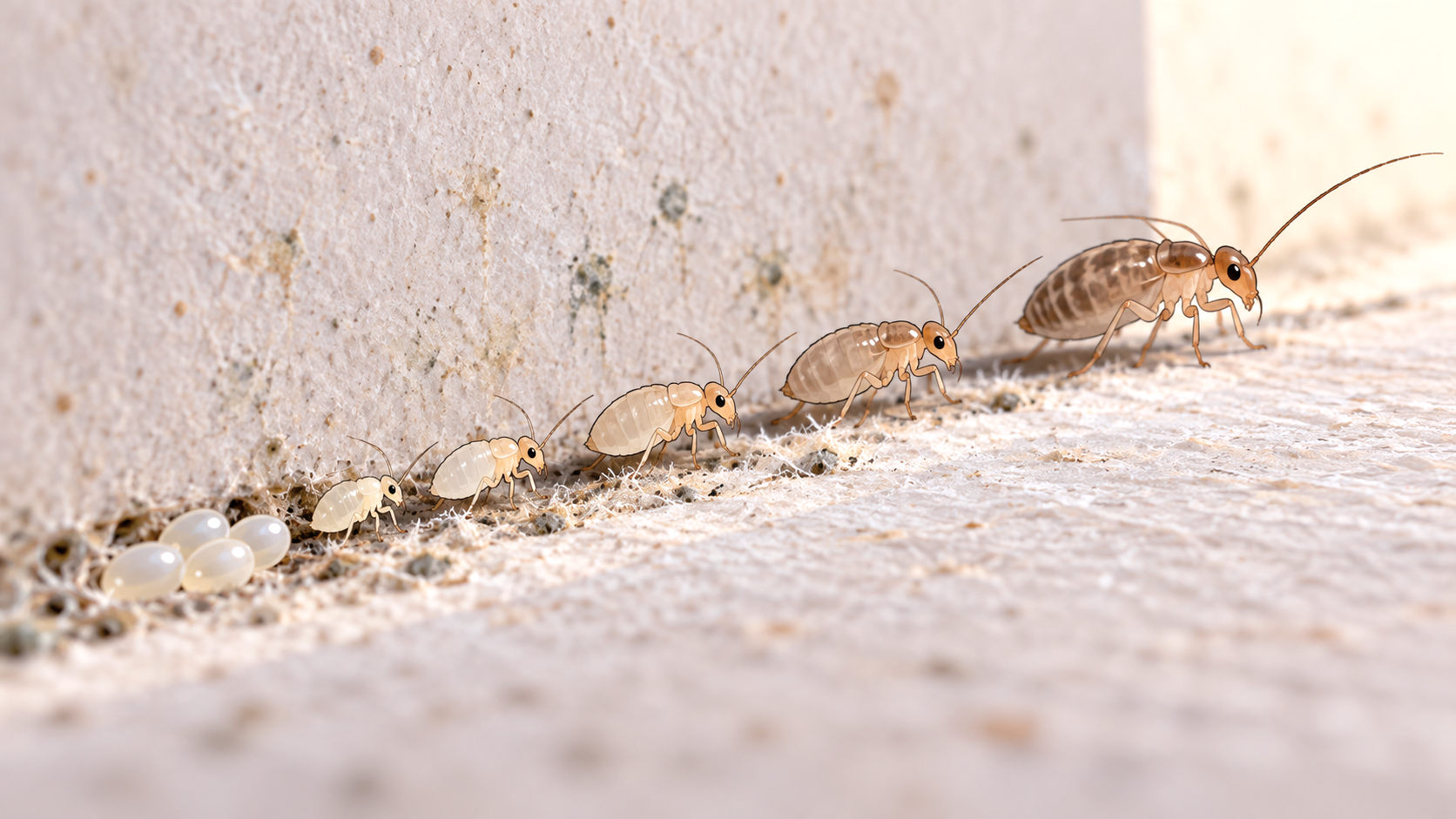
A booklouse does not hatch as a wormlike larva or spend part of its life inside a pupa. Instead, a newly hatched booklouse already resembles a miniature adult. It grows through a series of nymph stages, becoming larger with each molt until it reaches maturity.
The booklice life cycle has three main stages: egg, nymph, and adult. Booklice undergo simple metamorphosis, so there is no larval or pupal stage. Species commonly found inside buildings usually pass through four nymphal stages, and under warm conditions the entire journey from egg to adult can take less than one month. Temperature and moisture have a major influence on how quickly that cycle moves. A warm, humid environment with fungal growth can support rapid development, while cooler conditions slow reproduction and maturation considerably.
The Booklice Life Cycle Starts With an Egg
Female booklice lay very small eggs, usually placing them individually rather than producing an obvious cluster. The eggs are often concealed with debris, which makes them difficult to spot even when adult booklice are already noticeable nearby.
A female can produce about 60 eggs during warm summer conditions, although egg production falls when temperatures become cooler. The eggs are deposited in environments where the newly hatched nymphs will have access to suitable conditions and food. Indoors, that generally means humid locations where microscopic fungi and mold are growing.
Because booklice eggs are tiny and concealed, finding adults or nymphs is usually much easier than finding the eggs themselves. Their absence from view does not mean an indoor population is failing to reproduce.
The egg-laying behavior also separates booklice from the parasitic lice their common name brings to mind. Booklice do not attach eggs to human hair. They live independently in the environment and do not infest people.
Booklice Hatch as Nymphs, Not Larvae
When a booklouse egg hatches, a nymph emerges. This immature insect already has the recognizable basic form of a booklouse, although it is smaller and often paler than a mature individual.
That development is called simple metamorphosis, or incomplete metamorphosis. Unlike insects such as beetles and flies, booklice do not pass through a distinct larval stage followed by a pupa. Their development proceeds directly from egg through progressively larger nymphs to the adult.
This difference is useful when identifying very small insects indoors. If you find what appears to be a miniature booklouse alongside larger ones, it may simply be an immature individual. Young booklice can be nearly clear in color, while adults may be tan, gray, brown, dark brown, or orange-brown. The range of booklice colors can therefore be partly influenced by the developmental stages present in a population.
How Many Nymph Stages Do Booklice Have?
Booklice species commonly living in homes and other buildings usually have four nymphal stages. Each stage is known as an instar.
A nymph cannot simply expand continuously because its outer covering limits its growth. It must molt, shedding the old covering before continuing into the next developmental stage. The booklouse repeats this process as it progresses through its nymphal instars until the final molt produces an adult.
The nymphs remain similar in general appearance throughout this process. They become progressively larger rather than transforming into a completely different body form. Looking closely at booklice nymphs therefore reveals many of the same features seen in adults, including the relatively large head and long antennae.
The four-stage figure applies to booklice species commonly associated with buildings rather than every psocid species in existence. “Booklice” covers multiple related species, so developmental details should not be treated as identical across the entire order Psocodea.
How Long Does the Booklice Life Cycle Take?
Under warm conditions, booklice can complete their development from egg to adult in less than one month. Cooler conditions can stretch the same process to more than three months.
That variation is important because there is no single number of days that accurately describes every indoor booklouse population. Temperature directly affects development and reproduction. Females also produce fewer eggs under cooler conditions, so a temperature change can affect both how quickly individual booklice mature and how quickly the overall population increases.
This explains why different pest references can give different life-cycle durations without necessarily contradicting one another. A fixed figure presented without the environmental conditions behind it can make booklouse development seem more predictable than it actually is.
For a household infestation, the useful point is that booklice can mature quickly when their surroundings remain favorable. A warm, damp area can support another generation before a homeowner realizes the original insects were reproducing.
Humidity Helps Determine Whether the Cycle Continues
Temperature controls the speed of development, but moisture is central to whether indoor booklice can persist at all. Booklice commonly occupy damp, warm, undisturbed areas because those conditions support the molds and fungi they eat.
Indoor populations do not survive when relative humidity falls below about 45 to 50 percent. Another current extension recommendation notes that keeping relative humidity below 50 percent prevents mold growth and booklouse development. That makes moisture control much more than a way to make adult insects uncomfortable. It interferes with the conditions needed for the population to continue developing.
This connection also explains why booklice can suddenly become conspicuous in a recently damp room, around wet cardboard, or inside a building with trapped construction moisture. Understanding the relationship between booklice and humidity is often more useful than trying to kill each insect individually.
A common mistake is to focus on the visible adults while leaving the damp environment unchanged. Removing those insects does little to solve the underlying conditions that allowed eggs and nymphs to develop.
What Do Baby Booklice Look Like?
Baby booklice are nymphs, and they look much more like adults than many people expect. They have the same basic booklouse body plan but are smaller and may be considerably paler.
Booklice are already tiny as adults, commonly measuring around 1 to 2 millimeters. The youngest nymphs are smaller still, making them particularly easy to overlook. Their pale coloration can also make them blend into white walls, paper, shelving, and other light surfaces.
As the nymph develops through successive molts, it becomes larger and eventually reaches the mature adult form. There is no cocoon, chrysalis, maggotlike larva, or other dramatically different intermediate stage.
That simple development means a collection of different-sized booklice in one location can be evidence of an actively developing population. Size alone is not enough to determine the exact instar, but how big booklice are can help distinguish mature booklice from other household insects.
What Happens When a Booklouse Becomes an Adult?
The adult is the sexually mature stage of the booklice life cycle. Once development through the nymphal stages is complete, reproduction can continue and another generation begins with newly deposited eggs.
Common indoor booklice are wingless as adults. They do not acquire functional wings at the end of their development and suddenly begin flying around a room. The broader psocid group includes winged species, particularly outdoor forms commonly called barklice, but the Liposcelis species frequently found indoors are wingless booklice. The difference between those forms is important when considering whether booklice can fly.
Adults continue feeding in the same moisture-rich environments that supported the nymphs. Indoors, their food includes microscopic fungi and molds associated with damp materials. Paper, cardboard, books, and stored products can become places where booklice are found because those materials can support fungal growth when moisture is available.
How Quickly Can a Booklice Population Grow?
Booklice have the potential to increase noticeably when warm temperatures, high humidity, food, and shelter remain available. A female may produce around 60 eggs during warm summer conditions, while development from egg to adult can take less than a month under favorable temperatures.
Those numbers should not be converted into a simple population-growth formula. Not every egg necessarily produces a reproductive adult, environmental conditions fluctuate, and “booklice” includes multiple species with biological differences. What they do show is why a persistent moisture problem can support repeated generations in a relatively short period.
Large numbers are therefore more informative about the environment than about the age of the infestation. Booklice are particularly associated with damp conditions and fungal growth, so a growing population should prompt a search for excess humidity, condensation, leaks, wet materials, or another moisture source.
The signs of booklice may become easier to notice as numbers increase, but waiting until the insects are abundant gives the moisture problem more time to persist.
Do Booklice Reproduce All Year Indoors?
Booklice development responds strongly to temperature and humidity, so reproduction is not equally rapid under every indoor condition. Warm conditions can shorten development and increase egg production, while cooler temperatures slow both processes.
Heating, air conditioning, ventilation, dehumidification, local dampness, and the availability of fungal food can also create very different microclimates within the same building. A humid cabinet beside a plumbing leak may provide suitable conditions even when the room itself feels comfortable.
For that reason, the season outside does not tell you everything about a population living indoors. The conditions immediately surrounding the insects matter more. Booklice commonly occupy damp, warm and undisturbed places, and eliminating those conditions can interrupt their ability to persist.
Other Questions About the Booklice Life Cycle
Do booklice have a larval stage?
No. Booklice hatch as nymphs rather than larvae. The nymph resembles a smaller version of the adult and becomes progressively larger through successive molts.
Do booklice have a pupal stage?
No. There is no pupa between the nymph and adult stages. Booklice undergo simple metamorphosis, so their life cycle proceeds from egg to nymph to adult.
How many eggs can a female booklouse lay?
A female can produce about 60 eggs during warm summer conditions. Egg production decreases as temperatures become cooler, so this should not be treated as a fixed number for every female or environment.
Can booklice eggs survive after the adults are gone?
Removing visible adults does not establish that every egg or nymph has been removed from the area. The more effective approach is to change the environmental conditions supporting the population. Reducing indoor moisture prevents the fungal growth and booklouse development that allow the life cycle to continue.
6 thoughts on “Booklice Life Cycle: From Egg to Adult”