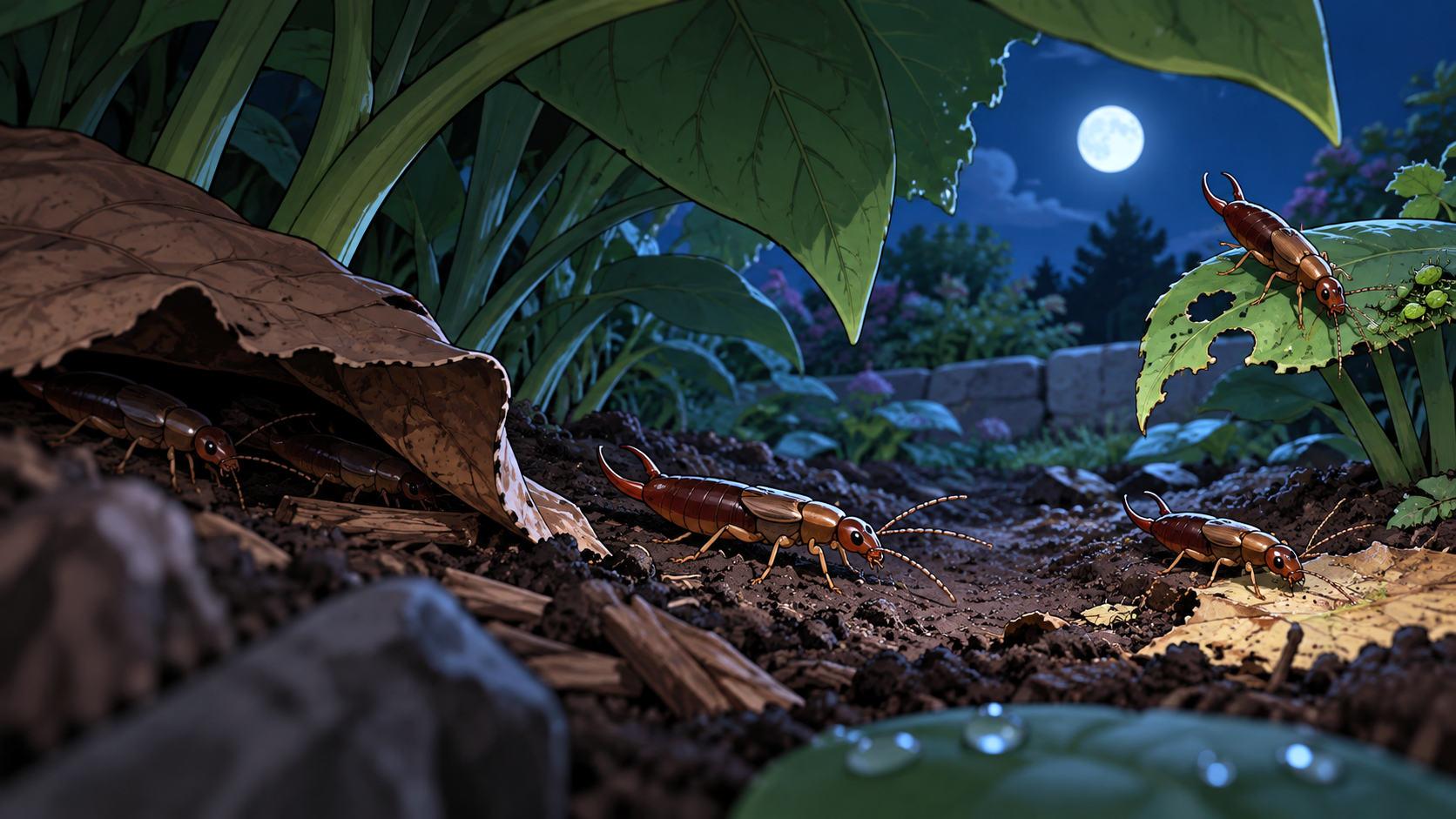
Yes, earwigs are nocturnal. They spend much of the day hidden in dark, tight, protected places and become active after dark. Night is when they commonly leave those shelters to search for food and moisture. That behavior is also why you may notice earwig damage without seeing the insects responsible during daylight hours.
Earwigs Are Most Active at Night
Seeing an earwig disappear under mulch during the day tells you very little about what it does once the sun goes down. European earwigs (Forficula auricularia) are active at night and sheltered during the day. Their nighttime activity includes moving away from hiding places and searching for food.
That feeding can involve both plant and animal material. European earwigs are omnivores that consume plant material, fungi, decaying organic matter and small invertebrates. They can therefore play two very different roles in a garden. They may prey on pests such as aphids and mites, but they can also chew leaves, flowers, seedlings and fruit.
Their nocturnal schedule helps explain an otherwise confusing garden problem. You can inspect damaged plants in the afternoon, find no obvious culprit, then discover earwigs on those same plants after dark. For that reason, nighttime observation is considerably more useful when you are trying to determine whether earwigs caused fresh chewing damage.
Where Do Earwigs Go During the Day?
Once daylight arrives, earwigs seek protected shelter. Dark, cool and moist locations are especially attractive daytime hiding places. Outdoors, that can include spaces beneath boards, mulch, weeds and clumps of soil. They can also shelter among dense vegetation and within damaged fruit.
Moisture matters because earwigs favor damp environments. This helps explain why conditions that attract earwigs often include both moisture and accessible shelter. A heavily mulched, irrigated garden can provide plenty of protected spaces where they can remain concealed until nighttime.
The hiding behavior can also bring earwigs into unexpected places. Turning over a flowerpot, lifting a board or moving damp garden debris may expose several insects that were almost impossible to spot moments earlier. They are not necessarily inactive simply because you cannot see them during the day. They are spending that part of their daily cycle under cover.
This is also why removing suitable daytime shelter can form part of earwig management. In areas where they are damaging plants, reducing hiding places and excessive moisture makes the environment less favorable.
What Time Do Earwigs Come Out?
There is no universal clock time when every earwig emerges. Darkness rather than a specific hour is the useful practical marker. As daylight fades, earwigs can leave protected daytime shelters and begin foraging.
That distinction matters because sunset changes with season and location. Telling someone to look for earwigs at exactly 9 p.m., for example, would be much less useful than telling them to inspect after dark. Their activity is tied to a nocturnal pattern, not a human schedule.
For homeowners, the simplest approach is to wait until it is fully dark and then inspect the affected area with a flashlight. Night inspection is specifically useful enough that earwigs can be confirmed on damaged plants by looking for them after dark.
We think this is one of the most useful things to know about earwig behavior. When the question is whether earwigs are actually eating a particular plant, repeatedly inspecting it at midday can waste your time. Looking at the same plant at night gives you a much better chance of catching the insects while they are active.
Baby Earwigs Also Begin Foraging at Night
The nocturnal pattern is not restricted to mature earwigs. However, very young European earwigs do not immediately behave like free-roaming adults.
After hatching, early nymphs remain associated with the nest and their mother. As they develop, the young begin leaving the nest to forage. Second-instar nymphs can search for food at night and return to shelter during the day. Later nymphal stages become free-foraging insects on the soil surface.
That development is worth separating from the simple statement that earwigs are nocturnal. A nest containing eggs or very young nymphs does not behave like a collection of adult earwigs roaming around a garden after dark. Our guide to the earwig life cycle covers those developmental stages in more detail.
Why You May Still See Earwigs During the Day
Nocturnal does not mean an earwig becomes impossible to see while the sun is up. You can expose one simply by disturbing the place where it was sheltering. Moving mulch, turning over a rock or lifting a container can suddenly put a hidden earwig in daylight.
You may also find them tucked into flowers, vegetables or other protected plant spaces during daytime inspections. Their presence there does not contradict their nocturnal behavior. The important distinction is between finding a sheltered earwig during the day and seeing the period when earwigs normally leave shelter to forage.
This is why we would not identify an insect’s activity pattern from one daytime encounter. First make sure the animal actually matches what an earwig looks like, particularly the characteristic pair of forceps at the rear of the abdomen. Then consider where it was found and whether its shelter had just been disturbed.
Use Their Nocturnal Behavior to Find Them
Earwig activity gives you a useful inspection strategy if plants are being damaged. Instead of relying only on the appearance of chewed leaves, return to the affected plants after dark with a flashlight. Examine the leaves, flowers, fruit and surrounding soil surface for active earwigs.
This is especially helpful because earwig feeding can resemble damage caused by other chewing pests. For example, both earwigs and slugs can leave irregular holes, although slug activity commonly leaves slime trails. Actually seeing an earwig feeding at night provides much stronger evidence than assuming every ragged leaf came from the first pest you suspect.
Daytime inspection still has a role. Rather than expecting earwigs to be wandering openly, inspect the sheltered places they use between periods of nighttime activity. Boards, plant debris and other protected damp spaces can reveal where they are hiding. If repeated inspections confirm that earwigs are causing unacceptable damage, the next step is choosing an appropriate earwig control strategy rather than treating unexplained plant damage blindly.
Other Questions About Earwig Nighttime Activity
Are earwigs attracted to lights at night?
Nighttime activity and attraction to artificial light are separate questions. Some earwigs can occur around lights, but being nocturnal does not by itself mean an insect is attracted to light. We cover that distinction separately in our guide to whether earwigs are attracted to light.
Do earwigs sleep during the day?
It is more accurate for a homeowner to think of daytime as the earwig’s main period of shelter rather than assuming that every concealed earwig is literally asleep. During daylight, they characteristically remain hidden in dark, tight and moist places instead of openly foraging.
Are earwigs active all night?
Earwigs are nocturnal and feed during the night, but that does not mean every individual remains continuously active from sunset until sunrise. Temperature, moisture, season and access to suitable shelter can affect when an individual is encountered.
Are earwigs more likely to enter a house at night?
Earwigs primarily disperse by crawling and can enter buildings through exterior openings. Their nighttime activity can therefore coincide with movement around a home’s exterior. However, repeated indoor sightings are better investigated by looking at entry points and outdoor conditions, which we cover in our guide to why earwigs get inside houses.
Can you find earwigs during the day without waiting until night?
Yes. Look in their daytime shelters rather than expecting them to be moving in the open. Dark, protected and damp spaces beneath outdoor objects and around vegetation are much more productive places to inspect.
19 thoughts on “Are Earwigs Nocturnal?”