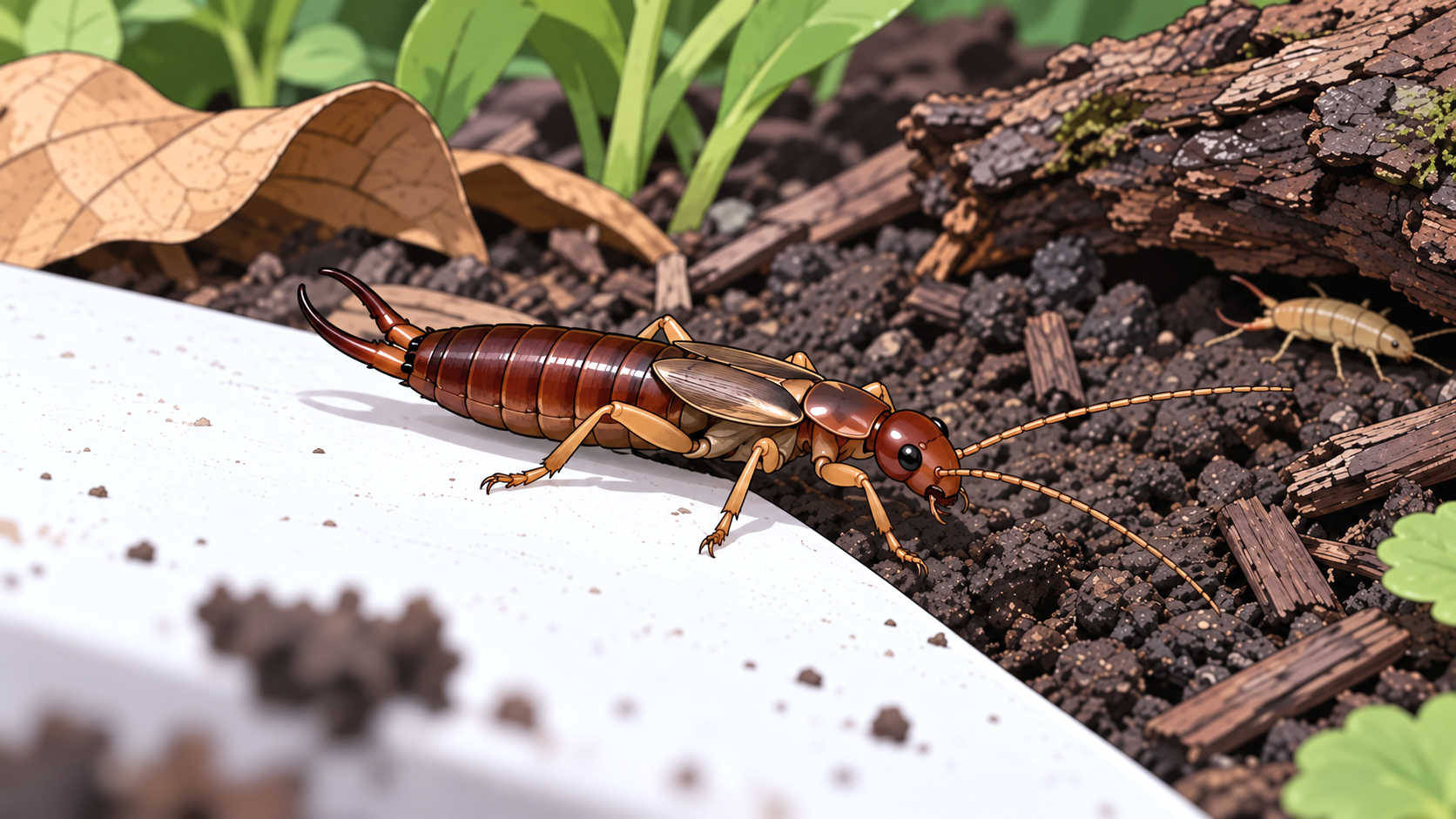
An earwig is a small, elongated insect best recognized by the pair of forceps-like pincers at the end of its abdomen. Those pincers make earwigs look considerably more threatening than they actually are. Earwigs belong to the insect order Dermaptera, and although several species occur in North America, the European earwig, Forficula auricularia, is one of the species most commonly encountered around homes and gardens. They spend much of the day hidden in dark, protected places, become more active at night, and feed on a broad mixture of plant material, decaying organic matter, fungi, and other small organisms.
For most homeowners, an earwig is more of a nuisance than a dangerous pest. It doesn’t seek out people, doesn’t infest the human body, and isn’t secretly trying to crawl into your ears despite the centuries-old story behind its name. Earwigs can occasionally damage flowers, seedlings, vegetables, and fruit when their numbers are high, but they can also be useful predators of other garden pests. Understanding that combination of behaviors is important because simply finding an earwig doesn’t necessarily mean you have something that needs to be eliminated.
What an Earwig Actually Looks Like
Once you know what to look for, adult earwigs are fairly distinctive. They have long, somewhat flattened bodies, prominent antennae, chewing mouthparts, and the unmistakable pair of cerci at the rear. Cerci are paired appendages found on the abdomen of some insects, but in earwigs they’ve developed into the conspicuous forceps most people simply call pincers. The University of Minnesota Extension describes adult European earwigs as about 5/8 inch long, with reddish-brown bodies, short leathery forewings, antennae, and strong forceps at the tip of the abdomen. The physical characteristics are easier to distinguish when you know what earwigs look like and which features separate them from similar-looking insects.
The pincers can also give you clues about the sex of an adult. Males generally have thicker, more strongly curved forceps, while females tend to have straighter, narrower ones. Those differences are particularly useful when comparing male and female earwigs. Young earwigs can be a little harder to recognize because they don’t emerge as completely different-looking larvae. Instead, the nymphs resemble smaller, lighter versions of the adults and gradually develop adult characteristics as they molt. Knowing what baby earwigs look like can help distinguish these immature stages from other tiny insects.
Another feature people often miss is that many earwigs have wings. In the European earwig, the functional hind wings are folded underneath very short, leathery forewings, so the insect doesn’t have the obvious wing profile you’d expect from a fly or wasp. European earwigs also rarely fly, which makes the wings even easier to overlook. This unusual arrangement explains why earwig wings are so easy to miss.
What Those Pincers Are Really For
The forceps are real defensive structures, but their appearance dramatically oversells the danger to people. Earwigs can use their cerci for defense, handling prey, mating-related behavior, and manipulating objects. The University of California Statewide Integrated Pest Management Program describes earwigs as harmless to people despite their intimidating forceps, while the University of Minnesota similarly treats earwigs that enter homes as nuisance insects rather than a threat to people, food, or the structure itself.
An earwig can use its forceps defensively if it’s handled or trapped against the skin, so saying that an earwig can never pinch would go too far. What matters is the scale of the threat. These insects aren’t equipped with a venomous stinger, and their presence in a house doesn’t create the sort of medical concern associated with pests such as certain spiders, ticks, or disease-vector mosquitoes. A closer look at what earwig pincers are actually used for helps explain why they have such conspicuous forceps, while whether earwigs are dangerous to humans puts the actual risk into perspective.
Where Earwigs Live and Why They Hide So Much
Earwigs are primarily nocturnal, which is one reason people can have plenty of them around a property without seeing much activity during the day. During daylight hours they seek out narrow, protected places where conditions are dark and often moist. Outside, that can mean underneath stones, boards, logs, loose bark, fallen leaves, mulch, flowerpots, garden debris, and dense vegetation. University of Maine Cooperative Extension describes earwigs hiding during the day in dark, damp locations beneath objects such as wood, boards, and rubbish before becoming active at night.
That preference helps explain why earwigs suddenly appear when you move a flowerpot or lift a damp board that has been sitting on the ground. It also explains why the insects are commonly associated with basements, bathrooms, and other areas where moisture is present. They’re not necessarily living openly in those spaces throughout the day. A narrow crack, gap, pile of organic material, or protected area nearby can provide the shelter they prefer, after which they emerge when conditions are suitable.
Their nighttime habits are worth separating from the idea that earwigs are incapable of appearing during daylight. Nocturnal describes their normal activity pattern, not a rule that prevents an individual from moving during the day when disturbed. Turning over a board and exposing several earwigs to sunlight, for example, will usually send them quickly looking for another protected place. This behavior is consistent with earwigs being primarily nocturnal rather than exclusively active after dark.
Why Earwigs Sometimes Come Inside
Finding an earwig in a house doesn’t automatically mean the insect is breeding indoors. Earwigs normally live outdoors and can wander into buildings through cracks, gaps, doors, windows, and other openings. The University of Minnesota Extension notes that European earwigs don’t reproduce indoors and describes the ones found inside houses as nuisance invaders rather than insects that establish destructive indoor populations.
That distinction matters when you’re deciding what to do next. One earwig discovered on a bathroom floor may simply have wandered inside. Repeatedly finding them throughout the house is more useful evidence that you should investigate where they’re entering and what conditions immediately outside the building are supporting them. Moist organic material, vegetation touching the structure, accumulated leaves, mulch, boards, firewood, and other sheltered areas can all provide favorable hiding places close to a foundation. Repeated sightings are one of the more useful signs of an earwig infestation.
Weather can change what you see as well. Earwigs need suitable moisture and shelter, and changes in outdoor conditions can push them toward different hiding places. This is one reason a homeowner may suddenly notice more earwigs during certain parts of the year even though the insects didn’t appear to be a problem previously. Their appearance indoors is therefore often better understood as movement from an outdoor population than as proof that they’ve built a colony somewhere inside the walls.
What Earwigs Actually Eat
Earwigs don’t fit neatly into the category of plant eater or predator because they’re omnivorous. Utah State University Extension describes European earwigs feeding on detritus, fungi, plant material, and insects. Depending on what is available, they may consume decaying organic matter, flowers, leaves, seedlings, fruit, or other small organisms.
That varied diet creates the strange situation where the same insect can be useful in one part of a garden and destructive in another. UC Statewide IPM notes that earwigs can be beneficial predators of aphids while also feeding on seedlings, flowers, soft fruit, and corn silks. Finding earwigs around plants therefore isn’t enough on its own to prove they’re causing the damage you’re seeing. You need to connect the insect with actual feeding activity.
This becomes especially important when the damage could have been caused by another nighttime pest. Earwig feeding can resemble damage caused by slugs and other chewing pests. The University of Minnesota notes that slug and earwig damage can look similar, but slugs leave behind characteristic slime trails while earwigs don’t. Inspecting affected plants after dark with a flashlight can help you see what’s actually feeding rather than blaming whichever insect happens to be nearby the following morning. This mixed role explains why the answer to whether earwigs are good or bad for your garden depends on what they’re doing there. Their varied diet is covered more specifically in what earwigs eat in the garden.
The Earwig Life Cycle Is More Unusual Than It Looks
Earwigs develop from eggs through several immature nymph stages before becoming adults. The young resemble smaller versions of the adults and grow through successive molts rather than passing through a caterpillar-like larval stage and pupa. What makes their development particularly interesting, though, isn’t simply the number of stages. It’s what the mother does while those early stages are developing.
Female earwigs show a level of maternal care that many people don’t expect from an insect they mostly know as the thing hiding beneath a flowerpot. A female creates a protected nest in the soil and remains with her eggs rather than simply depositing them and leaving. Utah State University Extension describes females defending their nests and tending their eggs, including removing mold and other hazards. That care can continue after the young hatch. Colorado State University Extension likewise notes that female earwigs guard their young during the early part of their development.
Because most encounters involve an adult running across a patio, basement floor, or garden bed, this hidden part of their biology is easy to miss. The stages from egg to adult are explained in the earwig life cycle, while how earwig mothers care for their young focuses on their unusual parental behavior.
The Story About Earwigs Crawling Into Human Ears
Few common insects have been saddled with a name that causes as much unnecessary alarm. The association between earwigs and human ears comes from an old superstition that the insects would crawl into the ear of a sleeping person and burrow into the brain. Penn State Extension discusses the folklore behind the name and makes clear that earwigs don’t behave this way, while University of Maine Cooperative Extension similarly describes the old belief as unfounded.
It’s important to phrase that accurately rather than replacing one exaggeration with another. A small wandering insect can accidentally end up in unusual places, and an earwig isn’t protected by some invisible barrier that makes physical entry into a human ear impossible. The myth is wrong because earwigs don’t seek out people’s ears as habitat, don’t routinely crawl into ears while people sleep, and certainly don’t burrow through the ear into the brain. An accidental incident involving an individual insect wouldn’t turn the folklore into normal earwig behavior. The superstition itself also helps explain why earwigs are called earwigs.
When Earwigs Become a Problem
The significance of an earwig depends heavily on where you’re finding it and what it’s doing. An earwig underneath a damp flowerpot outdoors is in normal habitat and may require no action whatsoever. Even several earwigs hiding together don’t necessarily indicate the kind of colony you would associate with ants or termites. Suitable hiding places can attract multiple individuals, and aggregation behavior can result in several occupying the same shelter. This distinction is important when considering whether earwigs live in colonies or alone.
The calculation changes when you’re repeatedly finding earwigs inside the house or when they’re causing identifiable garden damage. Indoors, the objective should be to work backward toward the entry route instead of treating every room where an earwig appears. Outdoors, the objective should be to determine whether they’re actually damaging plants before deciding that their presence alone justifies control. This avoids two opposite mistakes: ignoring a genuine recurring problem and killing beneficial or harmless insects simply because their appearance is unsettling.
Getting Earwigs Out Without Treating the Wrong Problem
For an occasional earwig indoors, sweeping or vacuuming it up is usually enough. If they keep appearing, exclusion becomes more important. UC IPM recommends sealing cracks and other openings, reducing hiding places near structures, clearing debris from gutters, and directing water away from buildings. It also notes that applying insecticides indoors won’t stop additional earwigs from entering from outside, which is why spraying the room where you happened to find one can miss the real source of the problem.
Outside, reducing unnecessary shelter can help when populations are excessive. Damp piles of leaves, debris, boards, and similar protected spaces give earwigs daytime refuge, particularly when they’re close to areas where the insects are causing trouble. Trapping is another option. UC IPM describes traps made from materials such as rolled newspaper, bamboo tubes, or short sections of hose. Earwigs enter these sheltered spaces during the day and can then be collected and removed. Different approaches to getting rid of earwigs can be used when control is actually necessary, while keeping earwigs out of the house focuses on preventing repeat indoor encounters.
The important part is not to turn every earwig sighting into an extermination project. These insects occupy a legitimate place in outdoor ecosystems, consume decaying material, and can prey on other pests. Control makes the most sense when they’re repeatedly entering living spaces or causing measurable damage to plants. Otherwise, the alarming-looking forceps can make a fairly ordinary garden insect seem like a much bigger problem than it is.
A Few More Things Worth Knowing About Earwigs
Are earwigs and pincher bugs the same thing?
Yes. In ordinary usage, “pincher bug” is a common nickname for an earwig, referring to the conspicuous forceps at the rear of its body. It isn’t the scientific name of a separate insect group. The relationship between the two names is explained more closely in pincher bug vs. earwig.
Do earwigs live in colonies?
Not in the highly organized social sense associated with ants, termites, or honey bees. You can still find many earwigs occupying the same favorable shelter, particularly where conditions are dark, protected, and moist. Their tendency to aggregate can make a hiding place look like a colony even though there isn’t an ant-like social structure operating inside it.
Can earwigs permanently infest the inside of a house?
European earwigs aren’t typical indoor-breeding household pests. University of Minnesota Extension states that they don’t reproduce indoors, while UC IPM describes indoor earwigs as invaders that eventually die. If you’re seeing them repeatedly, investigating outdoor populations, moisture conditions, and entry points is generally more useful than assuming there’s a reproducing colony somewhere inside the house.
Why do earwigs sometimes smell when they’re crushed?
Earwigs can produce defensive secretions with an unpleasant odor, which is why crushing or disturbing one can sometimes release a noticeable smell. The odor is part of the insect’s defensive biology rather than evidence that the earwig is venomous or dangerous to touch. The defensive response explains why earwigs can smell when they’re killed.
Should you kill an earwig when you find one in the garden?
Not automatically. Earwigs can damage certain plants, but they can also consume aphids, decaying material, and other organisms. If you’re seeing actual feeding damage, particularly on seedlings, flowers, soft fruit, or other vulnerable plants, control may be justified. If the earwig is simply hiding beneath a pot and the surrounding plants are healthy, its presence alone isn’t evidence that anything needs to be treated.
2 thoughts on “What Is an Earwig?”