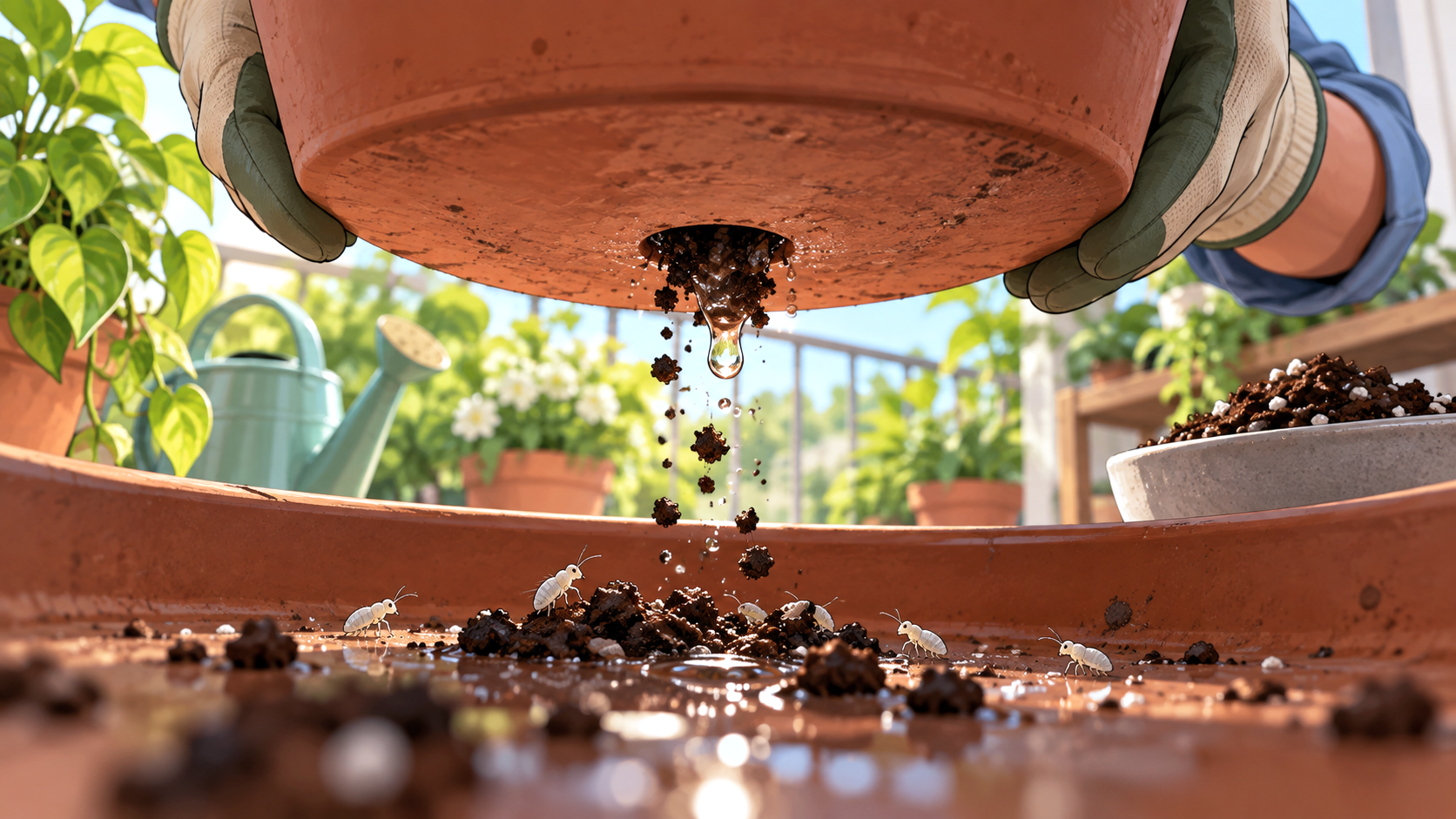
Springtails in potted plants usually do not require pesticides or drastic treatment. They thrive in damp potting media and mostly feed on fungi, decaying roots and other organic material rather than the plant. Start by adjusting the watering, allowing the soil surface to dry appropriately between waterings while still meeting the plant’s moisture needs. The most common mistake is treating the springtails as the main problem. A pot can contain a large population because its soil provides exactly what they need. Killing the visible springtails without changing those conditions does little to address why they became so numerous.
Why Springtails Show Up in Potted Plants
A flowerpot can be an excellent springtail habitat. Springtails need moisture, and most species feed on fungi, bacteria, algae and decaying organic material. Damp potting media provides moisture and can contain several of those food sources.
They are particularly associated with overwatered houseplants and damp potting mixes. Mixes containing a high proportion of peat can also favor them. The springtails may remain largely unnoticed within the media until something disturbs them.
Watering often provides that disturbance. Springtails living in the pot can move onto the soil surface after watering, suddenly making a population that was already there much easier to see. That is why a pot can appear springtail-free one day and seem covered with tiny jumping specks immediately after watering.
Moisture also explains more broadly what attracts springtails. In a flowerpot, the useful question is not simply how the springtails arrived. It is whether the potting media is staying wet enough to support a persistent population.
First, Make Sure They Really Are Springtails
Before changing how you care for the plant, confirm what is moving through the soil. Springtails are tiny, wingless arthropods, and many species use a forked structure called a furcula to launch themselves when disturbed. You can compare unfamiliar specimens with our guide to what springtails look like.
Do not rely on the fact that the creatures are small and live in potting soil. Fungus gnats are another frequent houseplant nuisance. Adult fungus gnats have wings and fly around plants, while springtails do not fly. Our springtails versus fungus gnats comparison covers the distinction in more detail.
Watching what happens immediately after watering is useful as well. Springtails often become conspicuous on wet soil at that point. A hand lens can make identification much easier when the animals are too small to examine clearly with the naked eye.
Do Springtails Hurt Potted Plants?
Springtails in houseplant soil cause little or no damage to the plant in most cases. They normally act as scavengers, feeding on decaying plant material and soil microorganisms.
That distinction changes how we would respond to them. A healthy plant with springtails moving across the potting mix does not need emergency pest treatment simply because the population looks large. Their numbers can be visually unpleasant without representing equivalent damage to the plant.
Some springtail species can feed on tender living plant tissue, so springtails should not be described as incapable of plant feeding. However, damage to plants is uncommon, and leaf-feeding damage is generally minor. Our article on whether springtails are harmful to plants deals specifically with that exception.
For a potted houseplant, therefore, the plant’s condition matters more than the number of springtails you can count. A thriving plant and a damaged plant call for different investigations, even when both pots contain springtails.
Let the Potting Soil Dry More Between Waterings
Reducing excessive soil moisture is the most useful response when springtails have become a nuisance. For houseplants with springtails, the recommended approach is to let the soil surface dry as much as the plant safely tolerates between waterings.
The plant’s requirements still come first. A cactus, fern and tropical foliage plant do not have identical watering needs, so there is no universal number of dry days to follow. The goal is not to dehydrate the plant. It is to stop keeping the potting medium unnecessarily wet.
This is where a springtail problem can actually be useful. The animals themselves usually pose little threat, but a conspicuous population can draw your attention to how wet the pot remains. Most container plants prefer moist rather than persistently soggy growing media.
Instead of watering automatically on a fixed calendar, check the growing medium and the needs of the particular plant. That addresses the habitat supporting the springtails without sacrificing the plant just to eliminate a harmless soil organism.
Check the Pot and Saucer for Excess Water
Changing the watering schedule will not help much if excess water has nowhere to go. A houseplant container should drain adequately, and the pot should not remain standing in collected water. Poor drainage can keep the growing medium wetter than intended even when you are not watering particularly often.
Look at the saucer after watering. If water collects there, empty it rather than allowing the bottom of the pot to sit in it. Good houseplant care includes preventing plants from standing in water.
Also inspect underneath the container. Springtails can occur beneath potted plants as well as within the soil. Finding them there does not mean they are attacking the roots. It may simply show that the damp area beneath the container is providing another suitable place to live.
You Usually Do Not Need to Repot the Plant
Seeing springtails does not automatically justify throwing away all the potting soil. If the plant is healthy and you can correct excessive moisture through better watering and drainage, we would start there.
Repotting becomes a more reasonable option when the growing medium itself is part of a broader problem. For example, fresh media may make sense when the existing mix remains excessively wet because its physical condition no longer suits the plant. Repotting can also be considered when you are already dealing with another soil-related plant problem.
Fresh potting media is an accepted management option for springtails in flowerpots, alongside allowing the existing media to dry between waterings. However, repotting purely to remove every springtail can create unnecessary work. If the replacement pot is kept continually wet, it can once again provide suitable conditions for moisture-loving organisms.
That is why we would treat repotting as a correction for the plant or potting medium, not as the default response to seeing springtails.
Skip Indoor Pesticide Sprays for Springtails in Potted Plants
A bottle of insecticide can feel like the obvious solution when dozens of tiny arthropods are moving across a flowerpot. In this situation, it solves the wrong problem.
Indoor springtail management centers on reducing the moisture that supports them. Indoor insecticide sprays are not recommended or necessary, and houseplant guidance similarly emphasizes allowing the soil surface to dry rather than treating the springtails with pesticides.
We would not reach for homemade chemical mixtures either. A treatment capable of contacting organisms throughout wet potting media also has to be considered in relation to the plant, the growing medium and anyone who may encounter it. There is little reason to introduce that complication when moisture management addresses the condition allowing the springtail population to persist.
For broader infestations extending beyond a flowerpot, our guide to getting rid of springtails covers the problem at household scale.
What to Do When Springtails Leave the Pot
Occasionally, the nuisance extends beyond seeing springtails on the soil. You may find them on the windowsill, shelf, floor or surface surrounding the plant.
Small numbers can simply be physically removed. Springtails need high moisture, so those leaving a favorable potting environment generally do poorly in dry indoor conditions. Their presence elsewhere in the room becomes more informative when the surrounding area is also persistently damp.
At that point, do not assume the flowerpot explains every springtail in the room. Plumbing leaks, condensation and other damp areas can support springtails indoors. Repeated sightings well away from the plants justify checking for another moisture source rather than repeatedly cleaning insects from the same surfaces.
The location of the population gives you a useful decision rule. Springtails concentrated in one damp flowerpot point toward the pot. Springtails repeatedly appearing throughout a damp room point toward a wider moisture issue.
Getting the Pot Back Into Balance
For most potted plants, the best response is surprisingly uneventful. Confirm that the tiny animals really are springtails, then look at how wet the pot stays. Allow appropriate drying between waterings, make sure excess water can drain, and empty water that collects in the saucer.
After that, judge the situation by the plant rather than by whether you can find a single remaining springtail. These arthropods naturally live in soil and feed largely on decomposing material and microorganisms. The objective does not need to be a sterile flowerpot.
A declining springtail population is useful evidence that the habitat has become less favorable to them. More importantly, the plant should be growing in a moisture regime that suits the plant, rather than one designed around eliminating every organism living in its potting mix.
Other Questions About Springtails in Potted Plants
Can springtails come home in a newly purchased plant?
Yes. Springtails can live within potting media, so a plant can already contain them when it enters your home. Inspecting newly acquired plants, their containers and their growing media before placing them with other houseplants can also reveal other potential plant pests.
Why do springtails float when I water my plant?
Springtails living within the pot can become much more noticeable after watering saturates the growing medium and they move onto the surface. Seeing a sudden concentration immediately after watering does not mean they appeared at that moment.
Should I isolate a plant because it has springtails?
Springtails alone are not comparable to a destructive houseplant pest feeding on leaves or stems. Isolation can still be useful while identifying an unknown organism, especially when you have not yet established that the tiny animals are springtails.
Can springtails live in the saucer under a flowerpot?
A consistently damp area beneath a pot can provide suitable conditions for springtails. Emptying standing water also prevents the plant from remaining in water longer than intended.
Will changing the potting mix guarantee the springtails are gone permanently?
No. Repotting removes the existing growing medium, but it does not make a plant permanently unsuitable for springtails. If the new medium remains consistently damp and provides suitable food and habitat, springtails can live there again.
17 thoughts on “Springtails in Potted Plants: What to Do About Them”